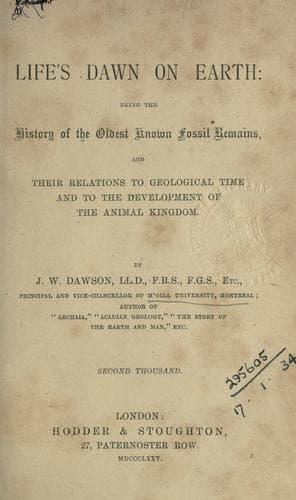
Life's Dawn on Earth: Being the history of the oldest known fossil remains, and their relations to geological time and to the development of the animal kingdomDawson, John William, Sir
History
Life's Dawn on Earth: Being the history of the oldest known fossil remains, and their relations to geological time and to the development of the animal kingdom
Dawson, John William, Sir
Life -- Origin; Paleontology -- Precambrian
"It may fairly be assumed that in the present world and in those
geological periods with whose organic remains we are more familiar
than with those of the Laurentian, there is no other source of
unoxidized carbon in rocks than that furnished by organic matter,
and that this has obtained its carbon in all cases, in the first
instance, from the deoxidation of carbonic acid by living plants. No
other source of carbon can, I believe, be imagined in the Laurentian
period. We may, however, suppose either that the graphitic matter
of the Laurentian has been accumulated in beds like those of coal,
or that it has consisted of diffused bituminous matter similar to
that in more modern bituminous shales and bituminous and oil-bearing
limestones. The beds of graphite near St. John, some of those in the
gneiss at Ticonderoga in New York, and at Lochaber and Buckingham
and elsewhere in Canada, are so pure and regular that one might
fairly compare them with the graphitic coal of Rhode Island. These
instances, however, are exceptional, and the greater part of the
disseminated and vein graphite might rather be compared in its mode
of occurrence to the bituminous matter in bituminous shales and
limestones.
"We may compare the disseminated graphite to that which we find in
those districts of Canada in which Silurian and Devonian bituminous
shales and limestones have been metamorphosed and converted into
graphitic rocks not dissimilar to those in the less altered portions
of the Laurentian.[G] In like manner it seems probable that the
numerous reticulating veins of graphite may have been formed by
the segregation of bituminous matter into fissures and planes of
least resistance, in the manner in which such veins occur in modern
bituminous limestones and shales. Such bituminous veins occur in
the Lower Carboniferous limestone and shale of Dorchester and
Hillsborough, New Brunswick, with an arrangement very similar to that
of the veins of graphite; and in the Quebec rocks of Point Levi,
veins attaining to a thickness of more than a foot, are filled with a
coaly matter having a transverse columnar structure, and regarded by
Logan and Hunt as an altered bitumen. These palæozoic analogies would
lead us to infer that the larger part of the Laurentian graphite
falls under the second class of deposits above mentioned, and that,
if of vegetable origin, the organic matter must have been thoroughly
disintegrated and bituminized before it was changed into graphite.
This would also give a probability that the vegetation implied was
aquatic, or at least that it was accumulated under water.
[Footnote G: Granby, Melbourne, Owl's Head, etc., _Geology of Canada_,
1863, p. 599.]
Public-domain text, read in full here on John Shaqi.
Reviews
Reviews
No reviews yet
Be the first to share your thoughts on this work.
Join the Discussion
Join the discussion
Sign in to leave a comment or review.
Sign InorCreate an account