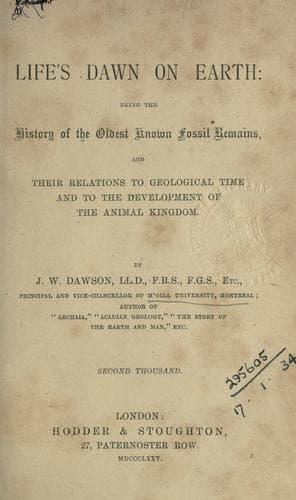
Life's Dawn on Earth: Being the history of the oldest known fossil remains, and their relations to geological time and to the development of the animal kingdomDawson, John William, Sir
History
Life's Dawn on Earth: Being the history of the oldest known fossil remains, and their relations to geological time and to the development of the animal kingdom
Dawson, John William, Sir
Life -- Origin; Paleontology -- Precambrian
"Dr. Hunt has, however, observed an indication of terrestrial
vegetation, or at least of subaërial decay, in the great beds of
Laurentian iron ore. These, if formed in the same manner as more
modern deposits of this kind, would imply the reducing and solvent
action of substances produced in the decay of plants. In this case
such great ore beds as that of Hull, on the Ottawa, seventy feet
thick, or that near Newborough, 200 feet thick,[H] must represent
a corresponding quantity of vegetable matter which has totally
disappeared. It may be added that similar demands on vegetable matter
as a deoxidizing agent are made by the beds and veins of metallic
sulphides of the Laurentian, though some of the latter are no doubt
of later date than the Laurentian rocks themselves.
[Footnote H: _Geology of Canada_, 1863.]
"It would be very desirable to confirm such conclusions as those
above deduced by the evidence of actual microscopic structure. It is
to be observed, however, that when, in more modern sediments, algæ
have been converted into bituminous matter, we cannot ordinarily
obtain any structural evidence of the origin of such bitumen, and in
the graphitic slates and limestones derived from the metamorphosis of
such rocks no organic structure remains. It is true that, in certain
bituminous shales and limestones of the Silurian system, shreds of
organic tissue can sometimes be detected, and in some cases, as in
the Lower Silurian limestone of the La Cloche mountains in Canada,
the pores of brachiopodous shells and the cells of corals have been
penetrated by black bituminous matter, forming what may be regarded
as natural injections, sometimes of much beauty. In correspondence
with this, while in some Laurentian graphitic rocks, as, for
instance, in the compact graphite of Clarendon, the carbon presents
a curdled appearance due to segregation, and precisely similar to
that of the bitumen in more modern bituminous rocks, I can detect in
the graphitic limestones occasional fibrous structures which may be
remains of plants, and in some specimens vermicular lines, which I
believe to be tubes of Eozoon penetrated by matter once bituminous,
but now in the state of graphite.
Public-domain text, read in full here on John Shaqi.
Reviews
Reviews
No reviews yet
Be the first to share your thoughts on this work.
Join the Discussion
Join the discussion
Sign in to leave a comment or review.
Sign InorCreate an account