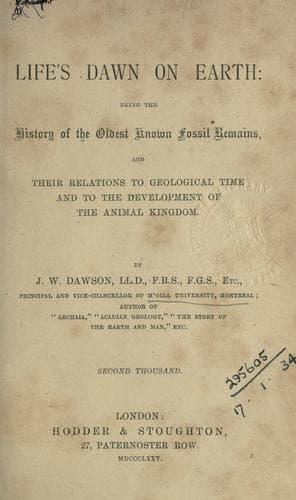
Life's Dawn on Earth: Being the history of the oldest known fossil remains, and their relations to geological time and to the development of the animal kingdomDawson, John William, Sir
History
Life's Dawn on Earth: Being the history of the oldest known fossil remains, and their relations to geological time and to the development of the animal kingdom
Dawson, John William, Sir
Life -- Origin; Paleontology -- Precambrian
upon them as fossils, and as such they were exhibited by me at the
meeting of the American Association for the Advancement of Science,
at Springfield, in August, 1859. See _Canadian Naturalist_, 1859,
iv., 300. In 1862 they were shown to some of my geological friends
in Great Britain; but no microscopic structure having been observed
belonging to them, few seemed disposed to believe in their organic
character, with the exception of my friend Professor Ramsay.
"One of the specimens had been sliced and submitted to microscopic
observation, but unfortunately it was one of those composed of
loganite and dolomite. In these, the minute structure is rarely
seen. The true character of the specimens thus remained in suspense
until last winter, when I accidentally observed indications of
similar forms in blocks of Laurentian limestone which had been
brought to our museum by Mr. James Lowe, one of our explorers, to
be sawn up for marble. In this case the forms were composed of
serpentine and calc-spar; and slices of them having been prepared
for the microscope, the minute structure was observed in the first
one submitted to inspection. At the request of Mr. Billings, the
palæontologist of our Survey, the specimens were confided for
examination and description to Dr. J. W. Dawson, of Montreal, our
most practised observer with the microscope; and the conclusions at
which he has arrived are appended to this communication. He finds
that the serpentine, which was supposed to replace the organic form,
really fills the interspaces of the calcareous fossil. This exhibits
in some parts a well-preserved organic structure, which Dr. Dawson
describes as that of a Foraminifer, growing in large sessile patches
after the manner of Polytrema and Carpenteria, but of much larger
dimensions, and presenting minute points which reveal a structure
resembling that of other Foraminiferal forms, as, for example
Calcarina and Nummulina.
Public-domain text, read in full here on John Shaqi.
Reviews
Reviews
No reviews yet
Be the first to share your thoughts on this work.
Join the Discussion
Join the discussion
Sign in to leave a comment or review.
Sign InorCreate an account