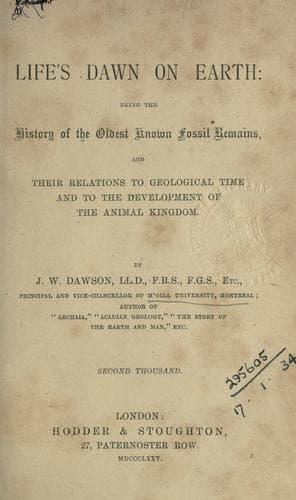
Life's Dawn on Earth: Being the history of the oldest known fossil remains, and their relations to geological time and to the development of the animal kingdom — John Shaqi
Life's Dawn on Earth: Being the history of the oldest known fossil remains, and their relations to geological time and to the development of the animal kingdomDawson, John William, Sir
History
Life's Dawn on Earth: Being the history of the oldest known fossil remains, and their relations to geological time and to the development of the animal kingdom
Dawson, John William, Sir
Life -- Origin; Paleontology -- Precambrian
"Dr. Dawson's description is accompanied by some remarks by Dr.
Sterry Hunt on the mineralogical relations of the fossil. He
observes that while the calcareous septa which form the skeleton of
the Foraminifer in general remain unchanged, the sarcode has been
replaced by certain silicates which have not only filled up the
chambers, cells, and septal orifices, but have been injected into
the minute tubuli, which are thus perfectly preserved, as may be
seen by removing the calcareous matter by an acid. The replacing
silicates are white pyroxene, serpentine, loganite, and pyrallolite
or rensselaerite. The pyroxene and serpentine are often found
in contact, filling contiguous chambers in the fossil, and were
evidently formed in consecutive stages of a continuous process. In
the Burgess specimens, while the sarcode is replaced by loganite, the
calcareous skeleton, as has already been stated, has been replaced
by dolomite, and the finer parts of the structure have been almost
wholly obliterated. But in the other specimens, where the skeleton
still preserves its calcareous character, the resemblance between
the mode of preservation of the ancient Laurentian Foraminifera, and
that of the allied forms in Tertiary and recent deposits (which,
as Ehrenberg, Bailey, and Pourtales have shown, are injected with
glauconite), is obvious.
"The Grenville specimens belong to the highest of the three already
mentioned zones of Laurentian limestone, and it has not yet been
ascertained whether the fossil extends to the two conformable lower
ones, or to the calcareous zones of the overlying unconformable
Upper Laurentian series. It has not yet either been determined
what relation the strata from which the Burgess and Grand Calumet
specimens have been obtained bear to the Grenville limestone or
to one another. The zone of Grenville limestone is in some places
about 1500 feet thick, and it appears to be divided for considerable
distances into two or three parts by very thick bands of gneiss.
One of these occupies a position towards the lower part of the
limestone, and may have a volume of between 100 and 200 feet. It is
at the base of the limestone that the fossil occurs. This part of
the zone is largely composed of great and small irregular masses of
white crystalline pyroxene, some of them twenty yards in length by
four or five wide. They appear to be confusedly placed one above
another, with many ragged interstices, and smoothly-worn, rounded,
large and small pits and sub-cylindrical cavities, some of them
pretty deep. The pyroxene, though it appears compact, presents a
multitude of small spaces consisting of carbonate of lime, and many
of these show minute structures similar to that of the fossil.
These masses of pyroxene may characterize a thickness of about 200
feet, and the interspaces among them are filled with a mixture of
serpentine and carbonate of lime.
Public-domain text, read in full here on John Shaqi.
Reviews
Reviews
No reviews yet
Be the first to share your thoughts on this work.
Join the Discussion
Join the discussion
Sign in to leave a comment or review.
Sign InorCreate an account