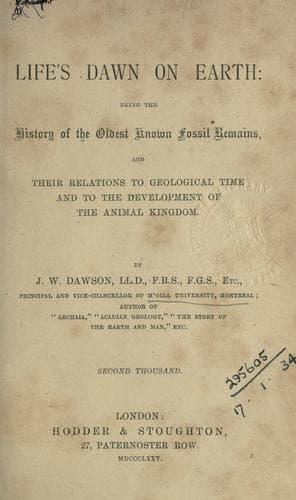
Life's Dawn on Earth: Being the history of the oldest known fossil remains, and their relations to geological time and to the development of the animal kingdomDawson, John William, Sir
History
Life's Dawn on Earth: Being the history of the oldest known fossil remains, and their relations to geological time and to the development of the animal kingdom
Dawson, John William, Sir
Life -- Origin; Paleontology -- Precambrian
In general a sheet of pure dark
green serpentine invests each mass of pyroxene; the thickness of the
serpentine, varying from the sixteenth of an inch to several inches,
rarely exceeding half a foot. This is followed in different spots
by parallel, waving, irregularly alternating plates of carbonate of
lime and serpentine, which become gradually finer as they recede
from the pyroxene, and occasionally occupy a total thickness of
five or six inches. These portions constitute the unbroken fossil,
which may sometimes spread over an area of about a square foot, or
perhaps more. Other parts, immediately on the outside of the sheet of
serpentine, are occupied with about the same thickness of what appear
to be the ruins of the fossil, broken up into a more or less granular
mixture of calc-spar and serpentine, the former still showing minute
structure; and on the outside of the whole a similar mixture appears
to have been swept by currents and eddies into rudely parallel and
curving layers; the mixture becoming gradually more calcareous as it
recedes from the pyroxene. Sometimes beds of limestone of several
feet in thickness, with the green serpentine more or less aggregated
into layers, and studded with isolated lumps of pyroxene, are
irregularly interstratified in the mass of rock; and less frequently
there are met with lenticular patches of sandstone or granular
quartzite, of a foot in thickness and several yards in diameter,
holding in abundance small disseminated leaves of graphite.
"The general character of the rock connected with the fossil produces
the impression that it is a great Foraminiferal reef, in which the
pyroxenic masses represent a more ancient portion, which having
died, and having become much broken up and worn into cavities and
deep recesses, afforded a seat for a new growth of Foraminifera,
represented by the calcareo-serpentinous part. This in its turn
became broken up, leaving in some places uninjured portions of the
general form. The main difference between this Foraminiferal reef and
more recent coral-reefs seems to be that, while in the latter are
usually associated many shells and other organic remains, in the more
ancient one the only remains yet found are those of the animal which
built the reef."
(B.) NOTE BY SIR WILLIAM E. LOGAN, ON ADDITIONAL SPECIMENS OF EOZOON.
[_Journal of Geological Society_, August, 1867.]
Public-domain text, read in full here on John Shaqi.
Reviews
Reviews
No reviews yet
Be the first to share your thoughts on this work.
Join the Discussion
Join the discussion
Sign in to leave a comment or review.
Sign InorCreate an account