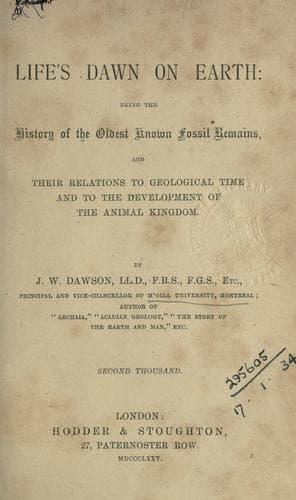
Life's Dawn on Earth: Being the history of the oldest known fossil remains, and their relations to geological time and to the development of the animal kingdom — John Shaqi
Life's Dawn on Earth: Being the history of the oldest known fossil remains, and their relations to geological time and to the development of the animal kingdomDawson, John William, Sir
History
Life's Dawn on Earth: Being the history of the oldest known fossil remains, and their relations to geological time and to the development of the animal kingdom
Dawson, John William, Sir
Life -- Origin; Paleontology -- Precambrian
"Since the subject of Laurentian fossils was placed before this
Society in the papers of Dr. Dawson, Dr. Carpenter, Dr. T. Sterry
Hunt, and myself, in 1865, additional specimens of Eozoon have been
obtained during the explorations of the Geological Survey of Canada.
These, as in the case of the specimens first discovered, have been
submitted to the examination of Dr. Dawson; and it will be observed,
from his remarks contained in the paper which is to follow, that one
of them has afforded further, and what appears to him conclusive,
evidence of their organic character. The specimens and remarks have
been submitted to Dr. Carpenter, who coincides with Dr. Dawson;
and the object of what I have to say in connection with these new
specimens is merely to point out the localities in which they have
been procured.
"The most important of these specimens was met with last summer by
Mr. G. H. Vennor, one of the assistants on the Canadian Geological
Survey, in the township of Tudor and county of Hastings, Ontario,
about forty-five miles inland from the north shore of Lake Ontario,
west of Kingston. It occurred on the surface of a layer, three inches
thick, of dark grey micaceous limestone or calc-schist, near the
middle of a great zone of similar rock, which is interstratified
with beds of yellowish-brown sandstone, gray close grained silicious
limestone, white coarsely granular limestone, and bands of dark
bluish compact limestone and black pyritiferous slates, to the whole
of which Mr. Vennor gives a thickness of 1000 feet. Beneath this zone
are gray and pink dolomites, bluish and grayish mica slates, with
conglomerates, diorites, and beds of magnetite, a red orthoclase
gneiss lying at the base. The whole series, according to Mr. Vennor's
section, which is appended, has a thickness of more than 12,000
feet; but the possible occurrence of more numerous folds than have
hitherto been detected, may hereafter render necessary a considerable
reduction.
Public-domain text, read in full here on John Shaqi.
Reviews
Reviews
No reviews yet
Be the first to share your thoughts on this work.
Join the Discussion
Join the discussion
Sign in to leave a comment or review.
Sign InorCreate an account