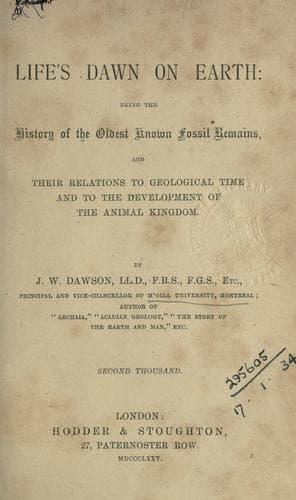
Life's Dawn on Earth: Being the history of the oldest known fossil remains, and their relations to geological time and to the development of the animal kingdomDawson, John William, Sir
History
Life's Dawn on Earth: Being the history of the oldest known fossil remains, and their relations to geological time and to the development of the animal kingdom
Dawson, John William, Sir
Life -- Origin; Paleontology -- Precambrian
"These measures appear to be arranged in the form of a trough,
to the eastward of which, and probably beneath them, there are
rocks resembling those of Grenville, from which the former differ
considerably in lithological character; it is therefore supposed
that the Hastings series may be somewhat higher in horizon than
that of Grenville. From the village of Madoc, the zone of gray
micaceous limestone, which has been particularly alluded to, runs
to the eastward on one side of the trough, in a nearly vertical
position into Elzivir, and on the other side to the northward,
through the township of Madoc into that of Tudor, partially and
unconformably overlaid in several places by horizontal beds of Lower
Silurian limestone, but gradually spreading, from a diminution of
the dip, from a breadth of half a mile to one of four miles. Where
it thus spreads out in Tudor it becomes suddenly interrupted for a
considerable part of its breadth by an isolated mass of anorthosite
rock, rising about 150 feet above the general plain, and supposed to
belong to the unconformable Upper Laurentian."
[Subsequent observations, however, render it probable that some of
the above beds may be Huronian.]
"The Tudor limestone is comparatively unaltered: and, in the specimen
obtained from it, the general form or skeleton of the fossil
(consisting of white carbonate of lime) is imbedded in the limestone,
without the presence of serpentine or other silicate, the colour of
the skeleton contrasting strongly with that of the rock. It does not
sink deep into the rock, the form having probably been loose and much
abraded on what is now the under part, before being entombed. On what
was the surface of the bed, the form presents a well-defined outline
on one side; in this and in the arrangement of the septal layers
it has a marked resemblance to the specimen first brought from the
Calumet, eighty miles to the north-east, and figured in the _Geology
of Canada_, p. 49; while all the forms from the Calumet, like that
from Tudor, are isolated, imbedded specimens, unconnected apparently
with any continuous reef, such as exists at Grenville and the Petite
Nation. It will be seen, from Dr. Dawson's paper, that the minute
structure is present in the Tudor specimen, though somewhat obscure;
but in respect to this, strong subsidiary evidence is derived from
fragments of Eozoon detected by Dr. Dawson in a specimen collected
by myself from the same zone of limestone near the village of Madoc,
in which the canal-system, much more distinctly displayed, is filled
with carbonate of lime, as quoted from Dr. Dawson by Dr. Carpenter
in the Journal of this Society for August, 1866.
Public-domain text, read in full here on John Shaqi.
Reviews
Reviews
No reviews yet
Be the first to share your thoughts on this work.
Join the Discussion
Join the discussion
Sign in to leave a comment or review.
Sign InorCreate an account