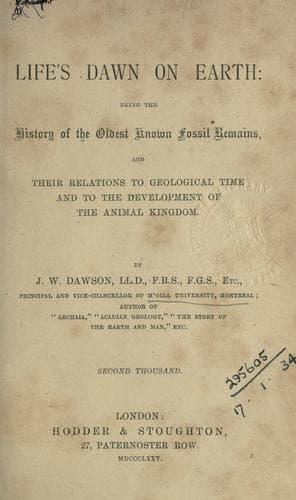
Life's Dawn on Earth: Being the history of the oldest known fossil remains, and their relations to geological time and to the development of the animal kingdomDawson, John William, Sir
History
Life's Dawn on Earth: Being the history of the oldest known fossil remains, and their relations to geological time and to the development of the animal kingdom
Dawson, John William, Sir
Life -- Origin; Paleontology -- Precambrian
"In Dr. Dawson's paper mention is made of specimens from Wentworth,
and others from Long Lake. In both of these localities the rock
yielding them belongs to the Grenville band, which is the uppermost
of the three great bands of limestone hitherto described as
interstratified in the Lower Laurentian series. That at Long Lake,
situated about twenty-five miles north of Côte St. Pierre in the
Petite Nation seigniory, where the best of the previous specimens
were obtained, is in the direct run of the limestone there: and like
it the Long Lake rock is of a serpentinous character. The locality
in Wentworth occurs on Lake Louisa, about sixteen miles north of
east from that of the first Grenville specimens, from which Côte St.
Pierre is about the same distance north of west, the lines measuring
these distances running across several important undulations in
the Grenville band in both directions. The Wentworth specimens are
imbedded in a portion of the Grenville band, which appears to have
escaped any great alteration, and is free from serpentine, though a
mixture of serpentine with white crystalline limestone occurs in the
band within a mile of the spot. From this grey limestone, which has
somewhat the aspect of a conglomerate, specimens have been obtained
resembling some of the figures given by Gümbel in his _Illustrations_
of the forms met with by him in the Laurentian rocks of Bavaria.
"In decalcifying by means of a dilute acid some of the specimens
from Côte St. Pierre, placed in his hands in 1864-65, Dr. Carpenter
found that the action of the acid was arrested at certain portions
of the skeleton, presenting a yellowish-brown surface; and he showed
me, two or three weeks ago, that in a specimen recently given him,
from the same locality, considerable portions of the general form
remained undissolved by such an acid. On partially reducing some
of these portions to a powder; however, we immediately observed
effervescence by the dilute acid; and strong acid produced it without
bruising. There is little doubt that these portions of the skeleton
are partially replaced by dolomite, as more recent fossils are
often known to be, of which there is a noted instance in the Trenton
limestone of Ottawa. But the circumstance is alluded to for the
purpose of comparing these dolomitized portions of the skeleton with
the specimens from Burgess, in which the replacement of the septal
layers by dolomite appears to be the general condition. In such of
these specimens as have been examined the minute structure seems to
be wholly, or almost wholly, destroyed; but it is probable that upon
a further investigation of the locality some spots will be found
to yield specimens in which the calcareous skeleton still exists
unreplaced by dolomite; and I may safely venture to predict that in
such specimens the minute structure, in respect both to canals and
Public-domain text, read in full here on John Shaqi.
Reviews
Reviews
No reviews yet
Be the first to share your thoughts on this work.
Join the Discussion
Join the discussion
Sign in to leave a comment or review.
Sign InorCreate an account