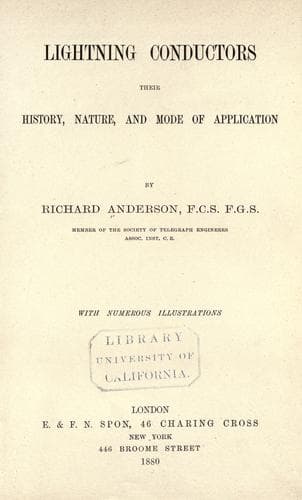
Lightning Conductors: Their History, Nature, and Mode of ApplicationAnderson, Richard, F.C.S.
History
Lightning Conductors: Their History, Nature, and Mode of Application
Anderson, Richard, F.C.S.
Lightning conductors
In the gradual spread of lightning conductors through the British
colonies of North America, Franklin himself took the leading part. He
employed all his leisure time, engrossed though it was more and more
by political affairs, in which he was destined to take a world-famous
part, in going from one part of the country to another, advocating the
use of conductors, advising as to the best mode of their construction,
and, whenever he could, examining into the effects of strokes of
lightning upon buildings. How minute he was in these inspections, and
how practical in the conclusions he almost invariably drew from them,
Franklin gives proof in one of his letters addressed to his friend
Collinson in London. He tells him that he inspected the church of
Newbury, in Massachusetts, which had been struck by lightning, and
traced, foot by foot and inch by inch, the road which the electric
current had taken, creating great havoc and destruction. ‘The steeple,’
he says, ‘was a square tower of wood, reaching seventy feet up from
the ground to the place where the bell hung, over which rose a taper
spire, of wood likewise, reaching seventy feet higher, to the vane
of the weathercock. Near the bell was fixed an iron hammer to strike
the hours; and from the tail of the hammer a wire went down through a
small gimlet-hole in the floor the bell stood upon; then horizontally
under and near the plastered ceiling of that second floor, till it came
to a wall; and then down by the side of this wall to a clock which
stood about twenty feet below the bell. The wire was not bigger than
a common knitting-needle.’ It surprised Franklin that ‘the lightning
passed between the hammer and the clock in this wire, without hurting
either of the floors, or having any effect upon them, except making
the gimlet-holes, through which the wire passed, a little bigger, and
without hurting the wall or any part of the building.’ The inference he
drew from this was, that even a comparatively thin mass of metal would
give passage to a powerful electric stream. ‘The quantity of lightning
that passed through the steeple,’ he informed his correspondent, ‘must
have been very great, as shown by its effects on the lofty spire above
the bell, and on the square tower below the end of the clock pendulum;
and yet, great as this quantity was, it was conducted by a small wire
and a clock pendulum, without the least damage to the building as far
as they extended.’
Public-domain text, read in full here on John Shaqi.
Reviews
Reviews
No reviews yet
Be the first to share your thoughts on this work.
Join the Discussion
Join the discussion
Sign in to leave a comment or review.
Sign InorCreate an account