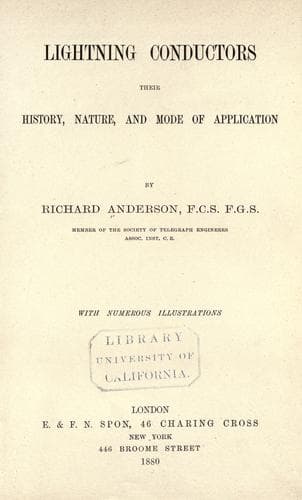
Lightning Conductors: Their History, Nature, and Mode of ApplicationAnderson, Richard, F.C.S.
History
Lightning Conductors: Their History, Nature, and Mode of Application
Anderson, Richard, F.C.S.
Lightning conductors
Besides travelling and employing lecturers, to make the advantages of
lightning conductors known, Franklin found means of doing so in an
annual publication he had started in the year 1732, known as ‘Poor
Richard.’ This almanac, humorous in form but very serious in substance,
which had acquired an enormous circulation, proved in the end the most
powerful instrument for spreading information on the great subject
dear, above all others, to Franklin’s heart, and leading his countrymen
to adopt, before all other nations, the wonderful metal rod, protective
against ‘the wrath of heaven.’ In several of the editions of the
almanac, notably the ‘Poor Richard’ for the year 1758, Franklin drew
attention to his lightning conductors in simple advertisements, drawn
up in a spirit of absolutely touching modesty and self-abnegation.
Not seeking the slightest reward for himself, nor even mentioning his
name, he only sought to benefit others by instructing them how to get
protection against the dangers of lightning. ‘It has pleased God,’
ran the advertisement in the almanac, ‘in His goodness to mankind, at
length to discover to them the means of securing their habitations and
other buildings from mischief by thunder and lightning. The method is
this:--Provide a small iron rod, which may be made of the rod-iron used
by nailers, but of such a length that, one end being three or four
feet in the moist ground, the other may be six or eight feet above the
highest part of the building. To the upper end of the rod fasten about
a foot of brass wire, the size of a common knitting-needle, sharpened
to a fine point; the rod may be secured on the house by a few small
staples. If the house or barn be long, there may be a rod and point at
each end, and a middling wire along the ridge from one to the other.
A house thus furnished will not be damaged by lightning, it being
attracted by the points and passing through the metal into the ground
without hurting anything. Vessels also, having a sharp-pointed rod
fixed on the top of their masts, with a wire from the foot of the rod
reaching down round one of the shrouds to the water, will not be hurt
by lightning.’ Franklin had occasion subsequently greatly to modify the
advice here given. He early discovered his error of lightning being
‘attracted by the points;’ and also found that his recommendation to
people to construct their own lightning conductors only led to grievous
calamities. There came reports from all sides of houses having been
severely damaged by lightning notwithstanding having conductors, and
close investigation soon showed that in every instance the apparatus
was defective, having been erected by unskilful hands, either the
owners themselves, or a set of wandering impostors, who soon made
themselves notorious as ‘lightning-rod men.’
Public-domain text, read in full here on John Shaqi.
Reviews
Reviews
No reviews yet
Be the first to share your thoughts on this work.
Join the Discussion
Join the discussion
Sign in to leave a comment or review.
Sign InorCreate an account