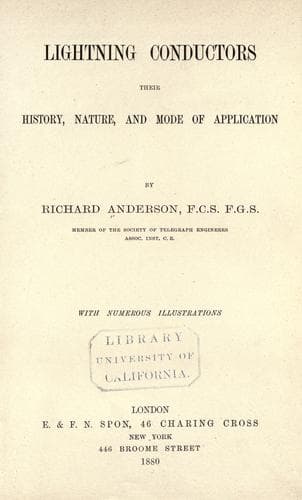
Lightning Conductors: Their History, Nature, and Mode of ApplicationAnderson, Richard, F.C.S.
History
Lightning Conductors: Their History, Nature, and Mode of Application
Anderson, Richard, F.C.S.
Lightning conductors
Perhaps the violent opposition which the erection of lightning
conductors--or ‘Franklin rods,’ as they were often called--met almost
everywhere, would have proved more effective than it ultimately turned
out, had not the great discoverer himself showed admirable temper in
meeting his enemies, thus pouring oil upon the stormy waters. His
calmness and confidence is admirably shown in a letter, dated July 2,
1768, addressed to Professor John Winthrop, of Cambridge, in answer to
one in which astonishment was expressed at the ‘force of prejudice,
even in an age of so much knowledge and free inquiry,’ of not placing
lightning conductors upon all elevated buildings. Franklin--or he must
now be called Dr. Franklin, having received the degrees of LL. D.
and D. C. L. from the universities of St. Andrew’s, Edinburgh, and
Oxford--was residing in England at the time, as agent of the people of
Pennsylvania. He was thoroughly acquainted with the state of public
feeling, yet so far from being angry, smiled down upon it like a
true philosopher. ‘It is perhaps not so extraordinary,’ he wrote to
his friend, ‘that unlearned men, such as commonly compose our church
vestries, should not yet be acquainted with, and sensible of, the
benefits of metal conductors in averting the stroke of lightning, and
preserving our houses from its violent effects, or that they should
still be prejudiced against the use of such conductors, when we see
how long even philosophers, men of science and of great ingenuity, can
hold out against the evidence of new knowledge that does not square
with their preconceptions; and how long men can retain a practice that
is conformable to their prejudices, and expect a benefit from such
practice, though constant experience shows its inutility. A late piece
of the Abbé Nollet, printed last year in the Memoirs of the French
Academy of Sciences, affords strong instances of this; for though
the very relations he gives of the effects of lightning in several
churches and other buildings show clearly that it was conducted from
one part to another by wires, gildings, and other pieces of metal
that were _within_, or connected with the building, yet in the same
paper he objects to the providing of metallic conductors _without_ the
building, as useless or dangerous. He cautions people not to ring the
church bells during a thunderstorm, lest the lightning, in its way to
the earth, should be conducted down to them by the bell ropes, which
are but bad conductors; and yet he is against fixing metal rods on the
outside of the steeple, which are known to be much better conductors,
and through which lightning would certainly choose to pass, rather than
through dry hemp. And though, for a thousand years past, church bells
have been solemnly consecrated by the Romish Church, in expectation
that the sound of such blessed bells would drive away thunderstorms,
and secure buildings from the stroke of lightning; and, during so long
Public-domain text, read in full here on John Shaqi.
Reviews
Reviews
No reviews yet
Be the first to share your thoughts on this work.
Join the Discussion
Join the discussion
Sign in to leave a comment or review.
Sign InorCreate an account