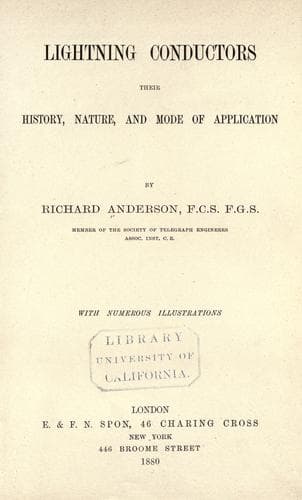
Lightning Conductors: Their History, Nature, and Mode of ApplicationAnderson, Richard, F.C.S.
History
Lightning Conductors: Their History, Nature, and Mode of Application
Anderson, Richard, F.C.S.
Lightning conductors
In the history of human inventions and discoveries, the idea of the
lightning conductor is almost the sole one which sprang, all but
perfect, from one brain, like Minerva, in Greek mythology, from
Jupiter’s head. Benjamin Franklin discovered the lightning conductor,
and, except some important improvements in its manufacture, due
to the progress of the metallurgical arts, the conductor remains
the same, in essence, as designed by the world-famous citizen of
Philadelphia. The reason of this is plain enough. Though one of the
most brilliant discoveries in the annals of mankind, the lightning
conductor, by itself, is one of the simplest of things. Franklin
found by experiments, that the mysterious so-called ‘electric fluid’
had a tendency to make its way in preference through metals, and so
he recommended the laying-down of a metallic line from the clouds to
the earth to prevent damage to surrounding objects, such as buildings
and the human beings within them. More than this he did not know; and
more than this we, to this day, do not know. Of the inner nature, or
constitution, of that grand cosmic discharge of electricity to which
the name of lightning is given, no scientific explanation can be given.
We are utterly ignorant of it, and in all probability ever will be.
But while the general principle laid down by Franklin, that metals
will conduct the electric force harmlessly from the clouds to the
earth, remains the same, very much has been learnt, in the progress of
scientific investigation, as regards the varying conducting capacity of
different metals. The first conductors were invariably rods of iron,
this metal being preferred by Franklin and his immediate followers
as cheap, ready at hand, and answering all purposes in practice. But
it was gradually found by experiments that there are other metals
through which the electric force will make its way more rapidly than
through iron. One of the earliest investigators of this subject was
Sir Humphrey Davy, the celebrated inventor of the miner’s safety lamp.
It was while studying the decomposition of the fixed alkalies by
galvanism, and tracing the metallic nature of their bases, to which
he gave the names of sodium and potassium, that the great chemist
and natural philosopher was brought to enter upon an examination of
what may be called the permeability of the different metals by the
electric force. The result of his investigations, as stated by him,
was that silver stood highest as a conductor of electricity; next to
it coming copper; then gold; next, lead; then platinum; then the new
metal called palladium--discovered by Wollaston, 1803, in platinum--and
lastly, iron. These were the principal metals experimented upon by
Sir Humphrey Davy, and the net result of his inquiries was expressed
summarily in the fact of copper being more than six times, and silver
more than seven times, as good a conductor as iron. Taking copper at
100, Sir Humphrey Davy drew up the following table of the electrical
Public-domain text, read in full here on John Shaqi.
Reviews
Reviews
No reviews yet
Be the first to share your thoughts on this work.
Join the Discussion
Join the discussion
Sign in to leave a comment or review.
Sign InorCreate an account