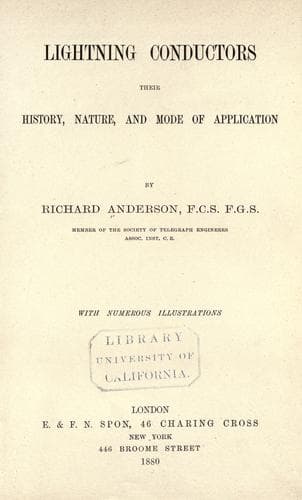
Lightning Conductors: Their History, Nature, and Mode of ApplicationAnderson, Richard, F.C.S.
History
Lightning Conductors: Their History, Nature, and Mode of Application
Anderson, Richard, F.C.S.
Lightning conductors
all the scientific men of the age, and, as deserved, set down as a man
out of his senses.
Nothing more was done for the next twenty-five years to enlarge the
knowledge of the phenomena of electricity. It stood, in fact, on a
footing not very far advanced from what it had been two thousand
years before. The achievements mainly consisted in a great number
of entertaining experiments performed for the delectation of great
and little children. Various machines had been made for exciting
electricity, but they served only, or at least chiefly, for amusement,
allowing ladies to fire off a cannon by a touch of their delicate hand,
and bringing ladies and gentlemen together to behold the wonderful
spectacle of an infant’s hair being made to stand on end, the little
creature having been placed upon cakes of resin, and fastened to the
ceiling by silken cords. The whole was little more than a repetition,
on a greater scale and with improved means, of the ancient Greek
experiment of rubbing a piece of amber on the sleeve of a philosopher’s
coat.
The first great step towards a practical insight into the nature and
phenomena of electricity, hitherto a mere plaything, was made in
the year 1745 in the ancient Dutch city and university of Leyden.
Two professors of the high school, John Nicholas Allamand, a member
of the Royal Society of London, and Peter Van Musschenbroek, author
of a treatise entitled ‘Introductio ad philosophiam naturalem,’ had
been trying, like many other scientific men of the time, electrical
experiments, when the thought occurred to them that the real reason
why all the work of the same kind had as yet produced such slight
results was that the electrical force was absolutely unstable. It
slipped, so to speak, through their hands, before they could look at
it; it vanished ‘like a dream, leaving no substance behind.’ One body,
they knew, had the power of electrifying another, but only to let
the mysterious force pass on, like a current of water running down a
cataract. Could they but ‘bottle up’ electricity, what a grand gain
would this be to science! So thought the two professors of Leyden
university; and thought justly. They went on experimenting, with this
end in view, till at last so-called ‘accident,’ the mother of millions
of human inventions and discoveries, threw a brilliant light on the
dark road along which they were groping their way.
Public-domain text, read in full here on John Shaqi.
Reviews
Reviews
No reviews yet
Be the first to share your thoughts on this work.
Join the Discussion
Join the discussion
Sign in to leave a comment or review.
Sign InorCreate an account