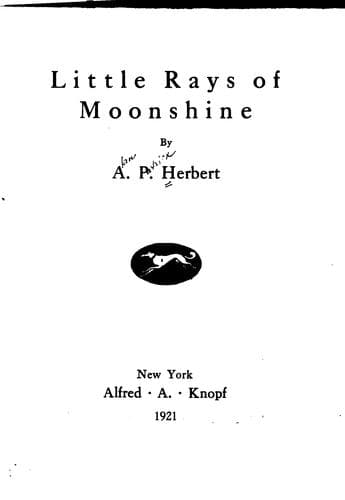
Little rays of moonshineHerbert, A. P. (Alan Patrick)
General
Little rays of moonshine
Herbert, A. P. (Alan Patrick)
English essays -- 20th century; English wit and humor
It was a really terrible noise. It hit you like the back-blast of an
explosion as you entered the room. There was no distinguishable tune.
It was simply an enormous noise. But there was a kind of savage rhythm
about it which made one think immediately of Indians and fierce men and
the native camps one used to visit at the Earl’s Court Exhibition. And
this was not surprising. For the musicians included one genuine negro
and three men with their faces blacked; and the noise and the rhythm
were the authentic music of a negro village in South Africa, and the
words which some genius had once set to the noise were an exhortation
to go to the place where the negroes dwelt.
To judge by their movements, many of the dancers had, in fact, been
there, and had carefully studied the best indigenous models. They were
doing some quite extraordinary things. No two couples were doing quite
the same thing for more than a few seconds so that there was endless
variety of extraordinary postures. Some of them shuffled secretly along
the edges of the room, their faces tense, their shoulders swaying like
reeds in a light wind, their progress almost imperceptible; they did
not rotate, they did not speak, but sometimes the tremor of a skirt
or the slight stirring of a patent-leather shoe showed that they were
indeed alive and in motion, though that motion was as the motion of a
glacier, not to be measured in minutes or yards.
And some in a kind of fever rushed hither and thither among the thick
crowd, avoiding disaster with marvellous dexterity; and sometimes they
revolved slowly and sometimes quickly and sometimes spun giddily round
for a moment like gyroscopic tops. Then they too would be seized with a
kind of trance, or it may be with sheer shortness of breath, and hung
motionless for a little in the centre of the room, while the mad throng
jostled and flowed about them like the leaves in autumn round a dead
bird.
And some did not revolve at all, but charged straightly up and down;
and some of these thrust their loves forever before them, as the
Prussians thrust the villagers in the face of the enemy, and some
forever navigated themselves backwards like moving breakwaters to
protect their darlings from the rude, precipitate seas.
Public-domain text, read in full here on John Shaqi.
Reviews
Reviews
No reviews yet
Be the first to share your thoughts on this work.
Join the Discussion
Join the discussion
Sign in to leave a comment or review.
Sign InorCreate an account