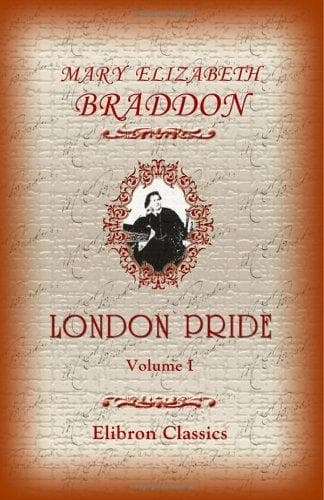
London Pride, Or, When the World Was YoungerBraddon, M. E. (Mary Elizabeth)
History
London Pride, Or, When the World Was Younger
Braddon, M. E. (Mary Elizabeth)
Great Britain -- History -- Charles II, 1660-1685 -- Fiction; London (England) -- Fiction
Her father’s visits to the Flemish city had been few and far apart,
fondly though he loved his motherless girl. He had been a wanderer for
the most part during those years, tossed upon troubled seas, fighting
with Condé against Mazarin and Anne of Austria, and reconciled with the
Court later, when peace was made, and his friends the Princes were
forgiven; an exile from France of his own free will when Louis banished
his first cousin, the King of England, in order to truckle to the
triumphant usurper. He had led an adventurous life, and had cared very
little what became of him in a topsy-turvy world. But now all things
were changed. Richard Cromwell’s brief and irresolute rule had
shattered the Commonwealth, and made Englishmen eager for a king. The
country was already tired of him whose succession had been admitted
with blank acquiescence; and Monk and the army were soon to become
masters of the situation. There was hope that the General was rightly
affected, and that the King would have his own again; and that such of
his followers as had not compounded with the Parliamentary Commission
would get back their confiscated estates; and that all who had suffered
in person or pocket for loyalty’s sake would be recompensed for their
sacrifices.
It was five years since Sir John’s last appearance at the convent, and
Angela’s heart beat fast at the thought that he was so near. She was to
see him this very day; nay, perhaps this very hour. His coach might
have passed the gate of the town already. He was bringing his elder
daughter with him, that sister whose face she had never seen, save in a
miniature, and who was now a great lady, the wife of Baron Fareham, of
Chilton Abbey, Oxon, Fareham Park, in the County of Hants, and Fareham
House, London, a nobleman whose estates had come through the ordeal of
the Parliamentary Commission with a reasonable fine, and to whom extra
favour had been shown by the Commissioners, because he was known to be
at heart a Republican. In the mean time, Lady Fareham had a liberal
income allowed her by the Marquise, her grandmother, and she and her
husband had been among the most splendid foreigners at the French
Court, where the lady’s beauty and wit had placed her conspicuously in
that galaxy of brilliant women who shone and sparkled about the sun of
the European firmament—Le roi soleil, or “the King,” par excellence,
who took the blazing sun for his crest. The Fronde had been a time of
pleasurable excitement to the high-spirited girl, whose mixed blood ran
like quicksilver, and who delighted in danger and party strife,
stratagem and intrigue. The story of her courage and gaiety of heart in
the siege of Paris, she being then little more than a child, had
reached the Flemish convent long after the acts recorded had been
forgotten at Paris and St. Germain.
Public-domain text, read in full here on John Shaqi.
Reviews
Reviews
No reviews yet
Be the first to share your thoughts on this work.
Join the Discussion
Join the discussion
Sign in to leave a comment or review.
Sign InorCreate an account