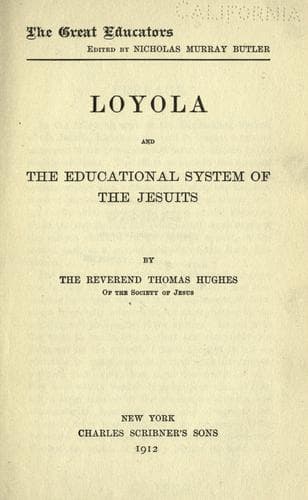
Loyola and the Educational System of the JesuitsHughes, Thomas
History
Loyola and the Educational System of the Jesuits
Hughes, Thomas
Education -- History; Ignatius, of Loyola, Saint, 1491-1556; Jesuits
He now entered on his theological studies. It was evident that the
obstructions, which had thwarted so many of his efforts heretofore,
were disappearing one by one. And more than that; the means were
being placed in his hands for the great work before him. These means
were a company of men. He was in the midst of a devoted little band,
each one of whom he had won individually. They were Peter Lefèvre and
Francis Xavier; James Lainez and Alphonsus Salmeron, both of them mere
youths; there were Claude Le Jay, John Coduri, Nicholas Bobadilla,
Simon Rodriguez; and lastly, the only one who at this time was a Priest
among their number, Pasquier Brouet. Among these, never at their head
though considered a father by all, never leading the way, though on
that account showing himself the more effectively a leader, Ignatius
was all in all to each one of them. He had previously acquired some
valuable experience in selecting and forming companions. But such as
had gathered round him in Spain were no longer with him. Each one of
his present party was a picked man.
When six of them were sufficiently advanced, he and they held a
solemnity, which was the real birthday of the Society of Jesus. On
the fifteenth day of August, 1534, they took a vow, in the church of
the Blessed Virgin, at Montmartre in Paris. They bound themselves to
renounce all their goods by a given date, and betake themselves to
the Holy Land; failing in that, they would throw themselves at the
feet of the Sovereign Pontiff, and offer him their absolute service.
Meanwhile they pursued their studies; and, as each of the two following
years brought round the fifteenth day of August, it found them in the
same place, and with the same solemnity, and with an enlarged number,
renewing this vow. The legal birthday of the Order came only with the
Papal charter on September 27, 1540.
I shall pass over the movements of Loyola, when bidden to go and
recuperate in his native climate. He returned to Spain, in 1535,
leaving his companions to study till 1537; and he settled the affairs
of his young Spanish associates at their homes. All, when the time
came, disposed of their goods in a summary way. They gave to the poor,
reserving nothing, except what would pay their way to Venice, and
thence to the East. Their principle was, _Dispersit, dedit pauperibus_,
"He hath distributed, he hath given to the poor." Besides this, Xavier,
at the date appointed, gave up the last stage of his theological
studies, and resigned the glory of receiving the Doctor's cap in Paris;
the brilliant young Professor sacrificed the one thing which had
appealed most powerfully to his ambition and imagination. Laynez was
recuperating from a severe illness, and could do scarcely more than
move. Nevertheless they are all in Venice, when the early spring of
1537 arrives.
Public-domain text, read in full here on John Shaqi.
Reviews
Reviews
No reviews yet
Be the first to share your thoughts on this work.
Join the Discussion
Join the discussion
Sign in to leave a comment or review.
Sign InorCreate an account