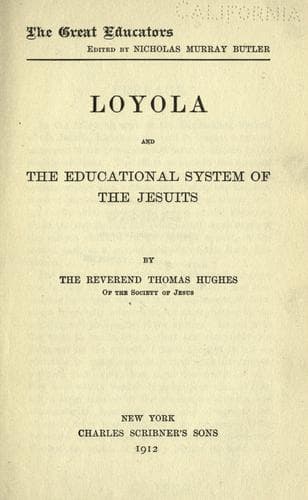
Loyola and the Educational System of the JesuitsHughes, Thomas
History
Loyola and the Educational System of the Jesuits
Hughes, Thomas
Education -- History; Ignatius, of Loyola, Saint, 1491-1556; Jesuits
Ignatius himself, meeting them there, has accomplished the work which
faced him thirteen years before, and which he had taken in hand with
his Latin grammar. He is now forty-six years of age.
There are three lines of activity, in which the ability and energy of
Ignatius Loyola stand out before the world. One is the capacity he
showed as a governor or leader of men; another is a similar competency
to direct souls in the spiritual life; the third is that, which we are
considering at present, his legislative genius in the intellectual
order. Admitting the innate talent which must have been the basis and
foundation of his gift for governing, we may affirm of all the rest,
that the best part of his sagacity and tact had been acquired by
personal experience. He learnt how to act by suffering. He perfected
his natural gift of guiding and commanding by first submitting to all
the contingencies of human life.
We may develop the meaning of this in the present matter, pedagogy;
and the meaning of it will help to unfold the subject. In quest of
the necessaries of life, he spent intervals of his studious career
in travelling from Paris to a great distance. He found himself
returning each year to Belgium, always on foot: he visited Rouen, and
even reached London, to address the Spanish merchants there. It does
not seem to have been parsimony on their side that kept him in such
straitened circumstances. It was his principles which were not all in
keeping with his conditions of life. He was endeavoring to combine
the life of a student with absolute poverty; and he aggravated the
inconveniences of such a state of dependence by placing no limits to
the exercise of his charity. It was his deliberate choice; for he fed
his mind continuously upon the life and example of the King, to whom
he had sworn his service, Christ poor and in labor from his youth. He
spoke afterwards from the wisdom of experience, when he said, that in
absolute penury the pursuit of science cannot easily subsist, and the
culture of the mind is impeded by the duties of providing for the body.
Hence he legislated that, though poverty was to be the basis of his
Institute, still the members, as long as they were engaged in studies,
should be set free from all care of seeking the means of subsistence.
He had endeavored to combine a life of apostolic ministrations, though
not yet a Priest, with that requisite absorption of mind, which alone
can warrant scholastic success. And he saw what it had come to. The
very esteem and love, which he entertained for the exercises of the
higher spiritual life, interrupted with intrusive thoughts that
application to study, which was the duty in hand. In order that no such
intrusion of even the most sacred pursuits should obstruct the onward
progress of the members in learning, he defined by rule the measure of
such occupations, as long as study was the main duty.
Public-domain text, read in full here on John Shaqi.
Reviews
Reviews
No reviews yet
Be the first to share your thoughts on this work.
Join the Discussion
Join the discussion
Sign in to leave a comment or review.
Sign InorCreate an account