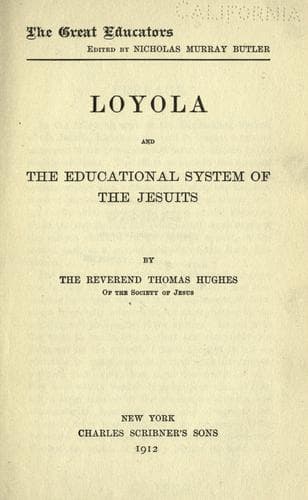
Loyola and the Educational System of the JesuitsHughes, Thomas
History
Loyola and the Educational System of the Jesuits
Hughes, Thomas
Education -- History; Ignatius, of Loyola, Saint, 1491-1556; Jesuits
Diseases weakened him. Therefore he took the greatest pains to protect
the health of the members. While he lived, he did this with a personal
and paternal solicitude. In his Institute, he provided the same for the
future.
On commencing his studies, he embraced many branches at the same
time; and he had suffered all the consequences of disorder. Grasping
at too many things, he lost all; and he had then to retrieve all with
loss of time. To obviate any recurrence of such costly experiences, he
provided that the courses followed in the Society should have nothing
disordered in them, nothing mutilated or curtailed; everything was to
be in method and system; until, system and method having been carried
out in every line, and the special good of each department having been
secured sufficiently for the general plan, specialized perfection
should be consulted, after all that; and this was to be the appointed
life of individuals, while a rounded and complete education remained
the culture of all.
Once in later years he let fall these words, relative to his early
experience: "He would very much question whether another but himself,
having to struggle with so many difficulties and obstacles in the
course of his studies, would have given so long a time to the
acquisition of the sciences."[15] Thus then was he oppressed with
poverty, without the satisfaction of acting under orders; suffering so
many diseases, and yet looking neither to honor, dignity, nor other
human reward, such as is wont to draw men on, and animate them under
fatigue; finding no pleasure nor satisfaction in the life of studies,
an inducement which is so great an alleviation to mortals in the work
before them. And, in all these respects, he was quite unlike the very
men whom he singled out, and enlisted in the new service of devotion;
unlike Francis Xavier, who had seen with perfect indifference all
his brothers take to their ancestral profession of arms, or to a
courtier's life, while he himself, with the whole force of an ambitious
soul, ran on successfully and brilliantly in his chosen career, as a
Professor; unlike Laynez and Salmeron, whose extraordinary gifts had
made them Doctors of Philosophy and Divinity, while still, in age,
little more than mere youths; very unlike by nature to the gentle
make of Lefèvre, who began life as a shepherd boy, and ever retained
a pastoral sweetness of character. Unlike all of them, Loyola, a
soldier born and bred, and still true to his profession, discarded
every consideration of taste, comfort, and convenience, in view of one
objective point to be reached: through thirteen years he struggled
towards it; and, when that time of probation was over, he was a marked
man. According to the law, that like attracts like, and like begets
like, he was surrounded by a company of marked men, few if you count
their number, many if you consider the type. His name was widely known,
and favorably so. When he had been paying five times over the price of
Public-domain text, read in full here on John Shaqi.
Reviews
Reviews
No reviews yet
Be the first to share your thoughts on this work.
Join the Discussion
Join the discussion
Sign in to leave a comment or review.
Sign InorCreate an account