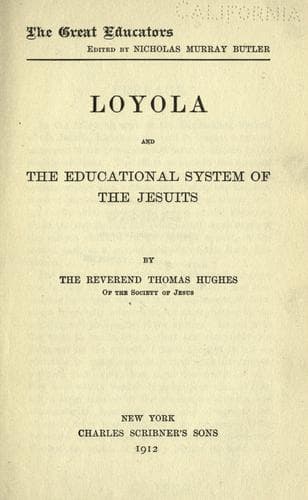
Loyola and the Educational System of the JesuitsHughes, Thomas
History
Loyola and the Educational System of the Jesuits
Hughes, Thomas
Education -- History; Ignatius, of Loyola, Saint, 1491-1556; Jesuits
When therefore Ignatius turned to the great Rome, he was like the
skilful commander whom he describes in a certain place; he was
possessing himself of the vantage-ground, taking the citadel. It would
be more correct to say, as all history avers, that he meant to defend
that citadel, the See of Rome. He had waited nearly a year at Venice,
to carry out his project of voyaging to Jerusalem. War made that
impossible. Now, in accordance with the express proviso in their vow,
he and his companions repaired to Rome, and offered their services to
the spiritual head of Christendom.
To win approbation for a new religious institute was no easy matter;
then less than ever. The recent occurrences in the North had been due
to this, among other moral causes, that the later history of certain
religious orders, which centuries before had begun one way, latterly
had taken a novel and fatal turn. Still, in spite of criticism and
hostility, chiefly in the high places, Ignatius received at length the
approving word of the Pope; and his Institute was chartered with a bull
of confirmation. Henceforth, the evolution of events belongs to general
history. What concerns us, in this chartering of the plan and Institute
of Ignatius Loyola, is the new character it gave to education, and the
epoch it made in the intellectual history of the world. To explain
this matter, we may follow briefly the deliberations which the Fathers
held, and in the course of which, among other conclusions, they came to
decide upon reëstablishing education.
It was the fourth of May, 1539, a year and a half before their services
were finally accepted by the Pope. Such of the ten members as were then
in Rome occupied themselves, after the labors of the day, in nightly
deliberations, which were protracted during three months. They decreed,
among other things, that they should teach boys and uncultured persons
the necessary points of Christian doctrine, at least once a year, and
for a definite time. This decree obviously is not about that secondary
and superior education of youth, which is our subject; neither does it
concern primary education, of which there is nowhere question in the
Institute of the Jesuits. But, as the Constitution subsequently drawn
up says, "this work of charity, in the Divine service, is more likely
to be consigned to oblivion, and to pass into disuse, than other duties
more specious in their character, as preaching," etc.[16]
Public-domain text, read in full here on John Shaqi.
Reviews
Reviews
No reviews yet
Be the first to share your thoughts on this work.
Join the Discussion
Join the discussion
Sign in to leave a comment or review.
Sign InorCreate an account