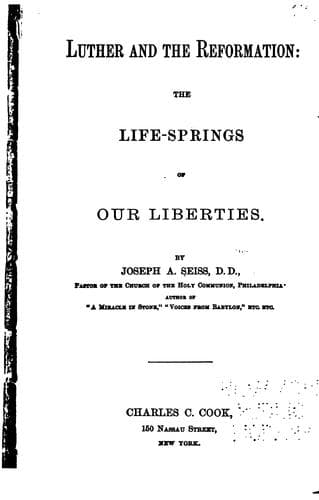
Luther and the Reformation:: The Life-Springs of Our LibertiesSeiss, Joseph Augustus
History
Luther and the Reformation:: The Life-Springs of Our Liberties
Seiss, Joseph Augustus
Luther, Martin, 1483-1546; Pennsylvania -- History -- Colonial period, ca. 1600-1775
But what are oaths and fore-pledges to candidates greedy for office?
The tickets which elected the new pope had hardly been counted when he
absolved himself from all previous obligations, disowned the senate of
cardinals he had helped to erect, began his career with violence and
robbery, plundered the cities and states of Italy, religiously
violated all compacts but those which favored his absolute supremacy,
brought to none effect the reform Council of Basle, deceived Germany
with his specious and hollow concessions, averted the improvements he
had sworn to make, and by his perfidy and cunning managed to retain in
subordination to the old regime nearly the whole of that Christendom
which he had outraged!
In spite of the efforts of centuries, this super-imperial power held
by the throat a struggling world.
To break that gnarled and bony hand, which locked up everything in its
grasp; to bring down the towering altitude of that olden tyranny,
whose head was lifted to the clouds; to strike from the soul its
clanking chains and set the suffering nations free; to champion the
inborn rights of afflicted humanity, and conquer the ignorance and
imposture which had governed for a thousand years,--constituted the
work and office of the man the four hundredth anniversary of whose
birth half the civilized world is celebrating to-day.
TIME OF THE REFORMATION.
It has been said that when this tonsured Augustinian came upon the
stage almost any brave man might have brought about the impending
changes. The Reformers before the Reformation, though vanquished, had
indeed not lived in vain. The European peoples were outgrowing feudal
vassalage, and moving toward nationalization and separation between
the secular and ecclesiastical powers. Travel, exploration, and
discovery had introduced new subjects of human interest and
contemplation. Schools of law, medicine, and liberal education were
being established and largely attended. The common mind was losing
faith in the professions and teachings of the old hierarchy. Free
inquiry was overturning the dominion of authority in matters of
thought and opinion. The intellect of man was beginning to recover
from the nightmare of centuries. A mightier power than the sword had
sprung up in the art of printing. In a word, the world was gravid with
a new era. But it was not so clear who would be able to bring it
safely to the birth.
There were living at the time many eminent men who might be thought of
for this office had it not been assigned to Luther. Reuchlin, Erasmus,
Huetten, Sickingen, and others have been named, but the list might be
extended, and yet no one be found endowed with the qualities to
accomplish the work that was needed and that was accomplished.
FREDERICK THE WISE.
Public-domain text, read in full here on John Shaqi.
Reviews
Reviews
No reviews yet
Be the first to share your thoughts on this work.
Join the Discussion
Join the discussion
Sign in to leave a comment or review.
Sign InorCreate an account