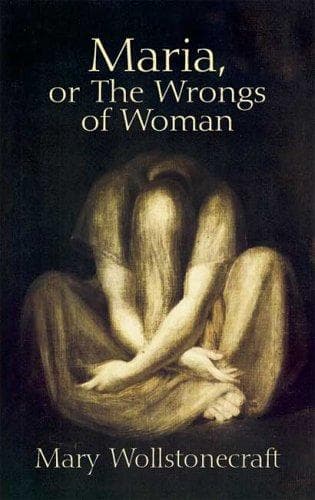
Maria; Or, The Wrongs of WomanWollstonecraft, Mary
General
Maria; Or, The Wrongs of Woman
Wollstonecraft, Mary
Autobiographical fiction; Feminist fiction; Women -- Fiction
Towards the evening, Jemima brought her Rousseau’s Heloise; and she sat
reading with eyes and heart, till the return of her guard to extinguish
the light. One instance of her kindness was, the permitting Maria to
have one, till her own hour of retiring to rest. She had read this work
long since; but now it seemed to open a new world to her—the only one
worth inhabiting. Sleep was not to be wooed; yet, far from being
fatigued by the restless rotation of thought, she rose and opened her
window, just as the thin watery clouds of twilight made the long silent
shadows visible. The air swept across her face with a voluptuous
freshness that thrilled to her heart, awakening indefinable emotions;
and the sound of a waving branch, or the twittering of a startled bird,
alone broke the stillness of reposing nature. Absorbed by the sublime
sensibility which renders the consciousness of existence felicity,
Maria was happy, till an autumnal scent, wafted by the breeze of morn
from the fallen leaves of the adjacent wood, made her recollect that
the season had changed since her confinement; yet life afforded no
variety to solace an afflicted heart. She returned dispirited to her
couch, and thought of her child till the broad glare of day again
invited her to the window. She looked not for the unknown, still how
great was her vexation at perceiving the back of a man, certainly he,
with his two attendants, as he turned into a side-path which led to the
house! A confused recollection of having seen somebody who resembled
him, immediately occurred, to puzzle and torment her with endless
conjectures. Five minutes sooner, and she should have seen his face,
and been out of suspense—was ever any thing so unlucky! His steady,
bold step, and the whole air of his person, bursting as it were from a
cloud, pleased her, and gave an outline to the imagination to sketch
the individual form she wished to recognize.
Feeling the disappointment more severely than she was willing to
believe, she flew to Rousseau, as her only refuge from the idea of him,
who might prove a friend, could she but find a way to interest him in
her fate; still the personification of Saint Preux, or of an ideal
lover far superior, was after this imperfect model, of which merely a
glance had been caught, even to the minutiae of the coat and hat of the
stranger. But if she lent St. Preux, or the demi-god of her fancy, his
form, she richly repaid him by the donation of all St. Preux’s
sentiments and feelings, culled to gratify her own, to which he seemed
to have an undoubted right, when she read on the margin of an
impassioned letter, written in the well-known hand—“Rousseau alone, the
true Prometheus of sentiment, possessed the fire of genius necessary to
pourtray the passion, the truth of which goes so directly to the
heart.”
Public-domain text, read in full here on John Shaqi.
Reviews
Reviews
No reviews yet
Be the first to share your thoughts on this work.
Join the Discussion
Join the discussion
Sign in to leave a comment or review.
Sign InorCreate an account