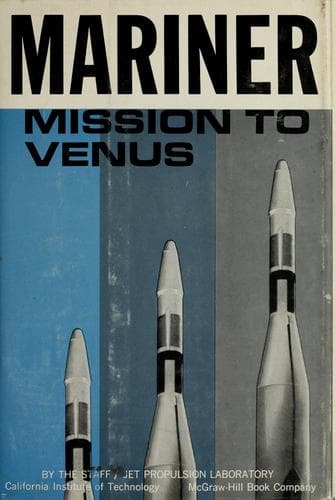
Mariner Mission to VenusJet Propulsion Laboratory (U.S.)
Science
Mariner Mission to Venus
Jet Propulsion Laboratory (U.S.)
Project Mariner (U.S.)
And the interception had to be so accurate that the spacecraft would
pass Venus within 8,000 to 40,000 miles. The chances of impacting the
planet could not exceed 1 in 1,000 because Mariner was not sterilized
and might contaminate Venus. Also, much more data could be gathered on a
near-miss flight path than on impact. Furthermore, at encounter (in the
target area) the spacecraft had to be so positioned that it could
communicate with Earth, see the Sun with its solar panels, and scan
Venus at the proper angles.
Along the way, Mariner had to be able to orient itself so that its solar
panels were facing or “locked onto” the Sun in order to generate its own
power; acquire and maintain antenna orientation to the Earth; correct
its attitude constantly to hold Earth and Sun lock; receive, store, and
execute commands to alter its course for a closer approach to Venus; and
communicate its findings to Earth with only 3 watts of radiated power
and over distances never before spanned.
[Illustration: _Mariner II was launched in a direction opposite to
the orbital travel of the Earth. The Sun’s gravity then pulled it in
toward the planet Venus._]
Early in the program it had been decided that two spacecraft would be
launched toward Venus. Only 56 days were available for both launchings
and the planet would not be close enough again for 19 months—the period
between inferior conjunctions or the planet’s closest approach to the
Earth. On any one of these days, a maximum of 2 hours could be used for
getting the vehicles off the launch pad. In addition, the Mariners would
have to leave the Earth in a direction opposite to that of the Earth’s
direction of orbital revolution around the Sun. This flight path was
necessary so the spacecraft could then fall in toward the Sun and
intercept Venus, catching and passing the Earth along the way, about 65
days and 11.5 million miles out.
This feat of celestial navigation had to be performed while passing
through the hostile environment of interplanetary space, where the probe
might be subjected to solar winds (charged particles) travelling at
velocities up to 500 miles per second; intense bombardment from cosmic
radiation, charged protons, and alpha particles moving perhaps 1.5
million miles per hour; radiated heat that might raise the spacecraft
temperatures to unknown values; and the unknown dangers from cosmic
dust, meteorites, and other miscellaneous space debris.
In flight, each spacecraft would have to perform more than 90,000
measurements per day, reporting back to the Earth on 52 engineering
readings, the changes in interplanetary magnetic fields, the density and
distribution of charged particles and cosmic dust, and the intensity and
velocity of low-energy protons streaming out from the Sun.
Public-domain text, read in full here on John Shaqi.
Reviews
Reviews
No reviews yet
Be the first to share your thoughts on this work.
Join the Discussion
Join the discussion
Sign in to leave a comment or review.
Sign InorCreate an account