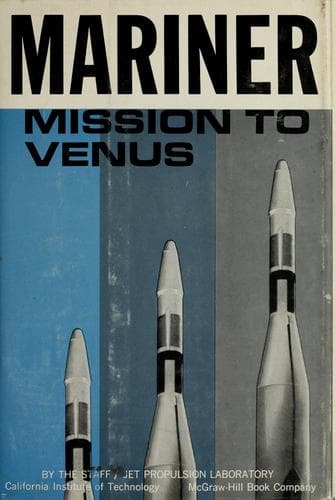
Mariner Mission to VenusJet Propulsion Laboratory (U.S.)
Science
Mariner Mission to Venus
Jet Propulsion Laboratory (U.S.)
Project Mariner (U.S.)
At its closest approach to Venus, the spacecraft instruments would be
required to scan the planet during a brief 35-minute encounter, to
gather data that would enable Earth scientists to determine the
temperature and structure of the atmosphere and the surface, and to
process and transmit that data back to the Earth.
THE ORGANIZATION
Flying Mariner to Venus was a team effort made possible through the
combined resources of several United States governmental organizations
and their contractors, science, and industry. The success of the Mariner
Project resulted primarily from the over-all direction and management of
the National Aeronautics and Space Administration and the Jet Propulsion
Laboratory, and the production and launch capabilities of the vehicle
builders and the Air Force. Several organizations bore the major
responsibility: NASA Headquarters, JPL, NASA’s Marshall Space Flight
Center and Launch Operations Center, Astronautics Division of General
Dynamics, and Lockheed Missiles and Space Company.
NASA: FOR SCIENCE
The National Aeronautics and Space Administration was an outgrowth of
the participation of the United States in the International Geophysical
Year program and of the nation’s space effort, revitalized following
Russia’s successful orbiting of Sputnik I in 1957.
[Illustration: _Final NACA meeting, August 21, 1958._]
[Illustration: _Model of X-1 research plane._]
[Illustration: _Headquarters of National Aeronautics and Space
Administration, Washington, D.C._]
[Illustration: _JPL developed first JATO units in 1941._]
[Illustration: _Other Laboratory Projects were the Corporal missile
(left) and Explorer I (right), the first U.S. satellite._]
Under the terms of the law which created NASA, it is a Federal Agency
dedicated to carrying out “activities in space ... devoted to peaceful
purposes for the benefit of all mankind.” NASA is charged to preserve
the role of our nation as a leader in the aeronautical and space
sciences and technology and to utilize effectively the science and
engineering resources of the United States in accomplishing these goals.
Activities associated with military operations in space and the
development of weapons systems are specifically assigned to the Defense
Department.
In November, 1957, before the creation of NASA, President Eisenhower had
established a Scientific Advisory Committee to determine the national
objectives and requirements in space and to establish the basic
framework within which science, industry, and the academic community
could best support these objectives.
The Committee submitted a report to the President in March, 1958,
recommending creation of a civilian agency to conduct the national space
programs. The recommendation, endorsed by the President, was submitted
to the Congress on April 2, 1958. The National Aeronautics and Space Act
of 1958 was passed and became law in July, 1958.
Public-domain text, read in full here on John Shaqi.
Reviews
Reviews
No reviews yet
Be the first to share your thoughts on this work.
Join the Discussion
Join the discussion
Sign in to leave a comment or review.
Sign InorCreate an account