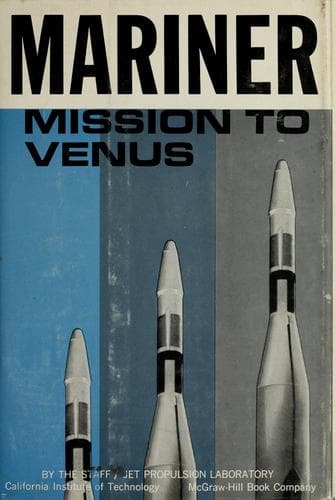
Mariner Mission to VenusJet Propulsion Laboratory (U.S.)
Science
Mariner Mission to Venus
Jet Propulsion Laboratory (U.S.)
Project Mariner (U.S.)
NASA was officially established on October 1, 1958, and Dr. T. Keith
Glennan, President of Case Institute of Technology, was appointed as the
first Administrator. The facilities and personnel of the National
Advisory Committee for Aeronautics (NACA) were transferred to form the
nucleus of the new NASA agency.
NACA had performed important and significant research in aeronautics,
wind tunnel technology, and aerodynamics since 1915, including a series
of experimental rocket research aircraft that culminated in the X-15. It
was natural that it be expanded to include space operations.
Among the NACA Centers transferred to NASA were the Langley Research
Center at Hampton, Virginia; Lewis Research Center, Cleveland, Ohio;
Ames Research Center, Moffett Field, California; Flight Research Center,
Edwards, California; and the rocket launch facility at Wallops Island,
Virginia.
Those personnel of the Naval Research Laboratory who had been working on
Project Vanguard were also transferred to NASA, as was the project.
These personnel are now part of the new Goddard Space Flight Center at
Greenbelt, Maryland.
The October, 1958, transfers also included a number of the space
projects of the Advanced Research Projects Agency of the Defense
Department. In a December, 1958, Executive Order, the President assigned
the former Army facilities of the Jet Propulsion Laboratory at Pasadena,
California, to NASA. At the same time, the group working under Dr.
Wernher von Braun at the Army Ballistic Missile Agency (commanded by
Major General John B. Medaris) was made responsive to NASA requirements.
On July 1, 1960, the George C. Marshall Space Flight Center (MSFC) was
organized at Huntsville under von Braun’s direction. The former
Development Operations Division of ABMA formed the nucleus of the new
Center. The MSFC mission was to procure and to supervise the adaptation
of launch vehicles for NASA space missions, including Atlas, Thor, and
Agena. Marshall is directly responsible for the design and development
of advanced, high-thrust booster vehicles such as the Saturn C-1 and C-5
and the Nova.
An agency to conduct NASA affairs at Cape Canaveral was formed within
MSFC on July 1, 1960. Known then as the Launch Operations Directorate
(LOD), it was directed by Dr. Kurt H. Debus. LOD became independent of
Marshall in March, 1962, when it was redesignated the Launch Operations
Center (LOC), reporting directly to the Office of Manned Space Flight.
This separation resulted largely because the activities at AMR were
becoming more operational in character and less oriented toward research
and development.
LOC handles such functions for NASA as the scheduling of launch dates
and liaison with the Atlantic Missile Range for support activities. The
Center will have the responsibility in the field for assembly, checkout,
and launch of the Saturn and Nova boosters.
Public-domain text, read in full here on John Shaqi.
Reviews
Reviews
No reviews yet
Be the first to share your thoughts on this work.
Join the Discussion
Join the discussion
Sign in to leave a comment or review.
Sign InorCreate an account