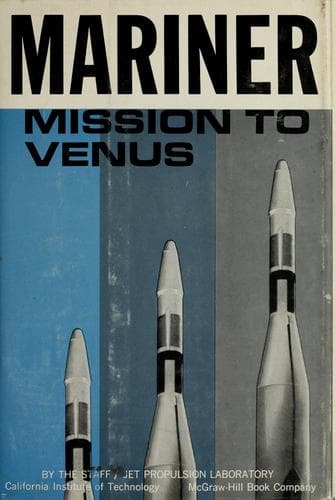
Mariner Mission to VenusJet Propulsion Laboratory (U.S.)
Science
Mariner Mission to Venus
Jet Propulsion Laboratory (U.S.)
Project Mariner (U.S.)
Following the election of President Kennedy in 1961, James E. Webb
replaced Dr. Glennan as Administrator of NASA. Shortly after, a new
national goal was announced—placing a man on the Moon and returning him
safely to the Earth in this decade. Meanwhile, JPL had been assigned
responsibility for unmanned exploration of the Moon, the planets, and
interplanetary space, and thus was charged with supporting the NASA
manned flight program through these activities.
In less than five years, NASA grew to include eight flight and research
centers and about 21,000 technical and management personnel. Within
NASA, Dr. Abe Silverstein’s Office of Space Flight Programs was
responsible for the Mariner R Project which was directly assigned to Ed
Cortright, Director of Lunar & Planetary Programs, and Fred
Kochendorfer, who is NASA’s Program Chief for Mariner. A subsequent
reorganization placed responsibility under Dr. Homer Newell’s Office of
Space Sciences, and Oran Nicks became Director of Lunar & Planetary
Programs.
JPL: JATO TO MARINER
The Jet Propulsion Laboratory, staffed and operated for NASA by
California Institute of Technology, had long been active in research and
development in the fields of missiles, rockets, and the space-associated
sciences. The first government-sponsored rocket research group in the
United States, JPL had originated on the Caltech campus in 1939, an
outgrowth of the Guggenheim Aeronautical Laboratories, then headed by
celebrated aerodynamicist Dr. Theodore von Karman.
Von Karman and his associates moved their operation to a remote spot at
the foot of the San Gabriel mountains and, working from this base, in
1941 the pioneering group developed the first successful jet-assisted
aircraft takeoff (JATO) units for the Army Air Force. The Laboratory
began a long association with the Army Ordnance Corps in 1944, when the
Private A test rocket was developed. In retrospect, it is now recognized
that the Private A was the first U. S. surface-to-surface,
solid-propellant rocket. Its range was 10 miles!
JPL’s WAC Corporal rocket set a U. S. high-altitude record of 43.5 miles
in 1945. Mounted on a German V-2 as the Bumper-WAC, it achieved an
altitude record of 250 miles in 1947. More important, this event was the
first successful in-flight separation of a two-stage rocket—the
feasibility of space exploration had been proved.
After the end of World War II, JPL research set the stage for
high-energy solid-propellant rockets. For the first time the solid
propellants, which contained both fuel and oxidizers, were cast in
thin-walled cases. Techniques were then developed for bonding the
propellants to the case, and burning radially outward from the central
axis was achieved. Attention was then turned to increasing the energy of
the propellants.
Public-domain text, read in full here on John Shaqi.
Reviews
Reviews
No reviews yet
Be the first to share your thoughts on this work.
Join the Discussion
Join the discussion
Sign in to leave a comment or review.
Sign InorCreate an account