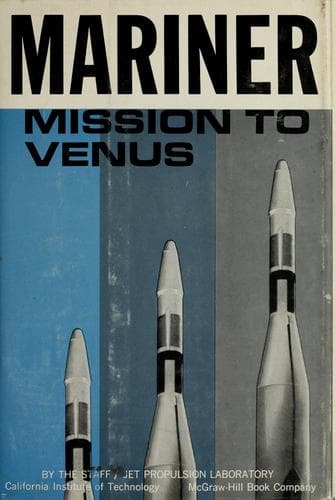
Mariner Mission to VenusJet Propulsion Laboratory (U.S.)
Science
Mariner Mission to Venus
Jet Propulsion Laboratory (U.S.)
Project Mariner (U.S.)
Another hold again delayed the count until 12:37 a.m., July 21, when
counting was resumed at T minus 165 minutes. The count then proceeded
without incident to T minus 79 minutes at 2:20 a.m., when uncertainty
over the cause of a blown fuse in the Range Safety circuits caused the
operations to be “scrubbed” or cancelled for the night. The next launch
attempt was scheduled for July 21-22.
The second launch countdown for Mariner I began shortly before midnight,
July 21. Spacecraft power had been turned on at 11:08 p.m., with the
launch count at T minus 200 minutes. At T minus 135 minutes, the weather
looked good. A 41-minute hold was required at minus 130 minutes (12:17
a.m., July 22) in order to change a noisy component in the ground
tracking system.
When counting was resumed at T minus 130 minutes, the clock read 12:48
a.m. A previously scheduled hold was called at T minus 60 minutes,
lasting from 1:58 to 2:38 a.m. The good weather still held.
At T minus 80 seconds, power fluctuations in the radio guidance system
forced a 34-minute hold. Time was resumed at 4:16 a.m., when the
countdown was set back to T minus 5 minutes.
At exactly 4:21.23 a.m., EST, the Atlas thundered to life and lifted off
the pad, bearing its Venus-bound load. The boost phase looked good until
the Range Safety officer began to notice an unscheduled yaw-left
(northeast) maneuver. By 4:25 a.m., it was evident that, if allowed to
continue, the vehicle might crash in the North Atlantic shipping lanes
or in some inhabited area. Steering commands were being supplied but
faulty application of the guidance equations was taking the vehicle far
off course.
Finally, at 4:26.16 a.m., after 293 seconds of flight and with just 6
seconds left before separation of the Atlas and Agena—after which the
launch vehicle could not be destroyed—a Range Safety officer hit the
“destruct” button.
A flash of light illuminated the sky and the choppy Atlantic waters were
awash with the glowing death of a space probe. Even as it fluttered down
to the sea, however, the radio transponder of the shattered Mariner I
continued to transmit for 1 minute and 4 seconds after the destroy
command had been sent.
Mariner I did not succumb easily.
MARINER II: A ROLL BEFORE PARKING
Ever since Mariner II had arrived at the Cape on June 4, test teams of
all organizations had labored day and night to prepare the spacecraft
for launch. The end of their efforts culminated after some 690 hours of
test time, both in California and in Florida.
Thirty-five days after Mariner I met its explosive end, the first
countdown on Mariner II was underway. At 6:43 p.m., EST, August 25,
1962, time was picked up. The countdown did not proceed far, however.
The Atlas crew asked for a hold at T minus 205 minutes (8:39 p.m.)
because of stray voltages in the command destruct system caused by a
defective Agena battery. After considerable delay, the launch effort was
scrubbed at 10:06 p.m.
Public-domain text, read in full here on John Shaqi.
Reviews
Reviews
No reviews yet
Be the first to share your thoughts on this work.
Join the Discussion
Join the discussion
Sign in to leave a comment or review.
Sign InorCreate an account