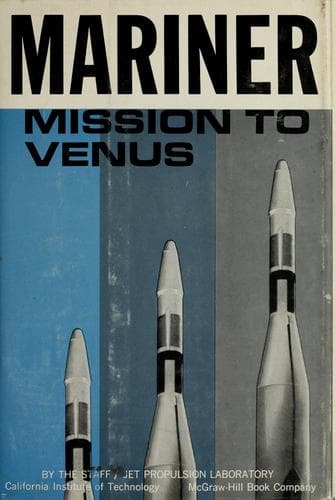
Mariner Mission to VenusJet Propulsion Laboratory (U.S.)
Science
Mariner Mission to Venus
Jet Propulsion Laboratory (U.S.)
Project Mariner (U.S.)
At 1:48 a.m., the count was resumed again at T minus 5 minutes. The long
seconds began to drag. Finally, the Convair test director pressed the
fire button.
Out on the launch pad, the Atlas engines ignited with a white puff and
began to strain against the retaining bolts as 360,000 pounds of thrust
began to build up. In a holocaust of noise and flame, the Atlas was
released and lifted off the launch pad on a bearing of 106.8 degrees at
exactly 1 hour, 53 minutes, 13.927 seconds in the morning of August 27,
1962.
Mariner II was on its way to listen to the music of the spheres.
As the launch vehicle roared up into the night sky, the JPL Launch
Checkout Station (DSIF O) tracked the spacecraft until Mariner
disappeared over the horizon. A quick, preliminary evaluation of
spacecraft data showed normal readings and Atlas seemed to be flying a
true course. The AMR in-flight data transmission and computational
operations were being performed as expected. With liftoff out of the
way, the launch began to look good.
After the radio signal from the ground guidance system cut off the
engines and the booster section was jettisoned, the remaining Atlas
forward section, plus the Agena and the spacecraft began to roll.
However, it stabilized itself in a normal attitude. Although the Atlas
had not gone out of the Range Safety restrictions, it was within just 3
degrees of exceeding the Agena horizon sensor limits, which would have
forced another aborted mission.
After the booster separation, the Atlas sustainer and vernier engines
continued to burn until they were shut off by radio guidance command.
Shortly thereafter, spring-loaded bolts ejected the nose-cone shroud
which had protected the spacecraft against frictional heating in the
atmosphere. Simultaneously, the gyroscopes in the Agena were started
and, at about 1:58 a.m., the Agena and the spacecraft separated from the
now-spent Atlas, which was retarded by small retro-rockets and drifted
back into the atmosphere, where it was destroyed by friction on reentry.
THE PARKING ORBIT
As the Agena separated from the Atlas booster vehicle, it was programmed
to pitch down almost 15 degrees, putting it roughly parallel with the
local horizon. Then, following a brief coasting period, the Agena engine
ignited at 1:58.53 a.m. and fired until 2:01.12 a.m. Cut-off occurred at
a predetermined value of velocity. Both the Agena and the spacecraft had
now reached a speed of approximately 18,000 miles per hour and had gone
into an Earth orbit at an altitude of 116.19 statute miles.
The second stage and the spacecraft were now in a “parking orbit,” which
would allow the vehicle to coast out to a point more favorable than Cape
Canaveral for blasting off Mariner for Venus.
Public-domain text, read in full here on John Shaqi.
Reviews
Reviews
No reviews yet
Be the first to share your thoughts on this work.
Join the Discussion
Join the discussion
Sign in to leave a comment or review.
Sign InorCreate an account