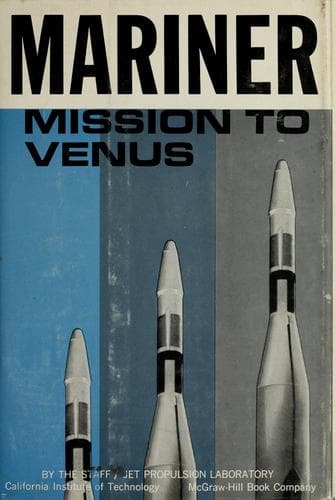
Mariner Mission to VenusJet Propulsion Laboratory (U.S.)
Science
Mariner Mission to Venus
Jet Propulsion Laboratory (U.S.)
Project Mariner (U.S.)
For the 106 days that Mariner was actually in Mode II (cruise), the
telemetry data were processed twenty-four hours a day, seven days a
week. Data were presented to the engineering and science analysis teams
in quick-look format every three hours, except for short maintenance
interruptions, one computer failure, and a major modification requiring
three days, when a back-up data process mode of operation was used. The
large computer performed full processing and analysis of engineering and
science data seven days a week from launch until the Venus encounter.
On encounter day, the secondary Station C computer processed telemetry
data from the high-speed Goldstone line. Data on magnetic tapes produced
by the computer were processed and analyzed by the large unit in
near-real time every 30 minutes. The computer processing and delivery
time during this operation varied from 4½ to 7 minutes.
CHAPTER 8
THE SCIENTIFIC EXPERIMENTS
After a year of concentrated effort, in which the resources of NASA, the
Jet Propulsion Laboratory, and American science and industry had been
marshalled, Mariner II had probed secrets of the solar system some
billions of years old.
Scientists and engineers had studied the miles of data processed in
California from the tapes recorded at the five DSIF tracking stations
around the world. Two and a half months of careful analysis and
evaluation yielded a revised estimate of Venus and of the phenomena of
space. As a result, the dynamics of the solar system were revealed in
better perspective and the shrouded planet stood partially unmasked.
When the Mariner data were correlated with the data gathered by JPL
radar experiments at Goldstone in 1961 and 1962, the relationships
between the Earth, Venus, and the Sun became far clearer than ever
before.
Two experiments were carried on the spacecraft for a close-up
investigation of Venus’ atmosphere and temperature characteristics—a
microwave radiometer and an infrared radiometer. They were designed to
operate during the approximate 35-minute encounter period and at a
distance varying from about 10,200 miles to 49,200 miles from the center
of the planet.[2]
[Illustration: _Cosmic dust detector._]
[Illustration: _Solar plasma spectrometer._]
COLLECTOR CUP
PROGRAMMER
ELECTROMETER
DEFLECTION PLATES
[Illustration: _Magnetometer._]
[Illustration: _High-energy particle detector._]
COLLECTOR
SHIELD CAN
QUARTZ FIBER
[Illustration: _Microwave and infrared radiometers._]
REFERENCE HORNS
MICROWAVE RADIOMETER
INFRARED RADIOMETER
_Table 2. Mariner Experiments_
_Experiment_ _Description_ _Experimenters_
Public-domain text, read in full here on John Shaqi.
Reviews
Reviews
No reviews yet
Be the first to share your thoughts on this work.
Join the Discussion
Join the discussion
Sign in to leave a comment or review.
Sign InorCreate an account