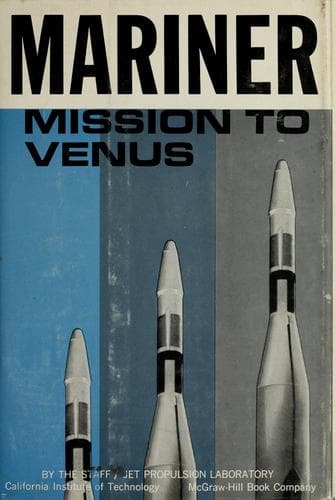
Mariner Mission to VenusJet Propulsion Laboratory (U.S.)
Science
Mariner Mission to Venus
Jet Propulsion Laboratory (U.S.)
Project Mariner (U.S.)
Microwave radiometer Determine the Dr. A. H. Barrett,
temperature of the Massachusetts
planet surface and Institute of
details concerning Technology; D. E.
its atmosphere Jones, JPL; Dr. J.
Copeland, Army
Ordnance Missile
Command and
Ewen-Knight Corp.;
Dr. A. E. Lilley,
Harvard College
Observatory
Infrared radiometer Determine the Dr. L. D. Kaplan, JPL
structure of the and University of
cloud layer and Nevada; Dr. G.
temperature Neugebauer, JPL; Dr.
distributions at C. Sagan, University
cloud altitudes of California,
Berkeley, and Harvard
College Observatory
Magnetometer Measure planetary and P. J. Coleman, NASA;
interplanetary Dr. L. Davis,
magnetic fields Caltech; Dr. E. J.
Smith, JPL; Dr. C. P.
Sonett, NASA
Ion chamber and Measure high-energy Dr. H. R. Anderson,
matched cosmic radiation JPL; Dr. H. V. Neher,
Geiger-Mueller tubes Caltech
Anton special-purpose Measure lower Dr. J. Van Allen and
tube radiation (especially L. Frank, State
near Venus) University of Iowa
Cosmic dust detector Measure the flux of W. M. Alexander,
cosmic dust Goddard Space Flight
Center, NASA
Solar plasma Measure the intensity M. Neugebauer and Dr.
spectrometer of low-energy C. W. Snyder, JPL
positively charged
particles from the Sun
Four experiments for investigation of interplanetary space and the
regions near Venus employed: a magnetometer; high-energy charged
particle detectors, including an ionization chamber and Geiger-Mueller
radiation counters; a cosmic dust detector; and a solar plasma detector.
Public-domain text, read in full here on John Shaqi.
Reviews
Reviews
No reviews yet
Be the first to share your thoughts on this work.
Join the Discussion
Join the discussion
Sign in to leave a comment or review.
Sign InorCreate an account