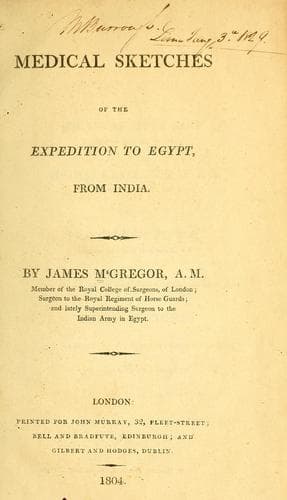
Medical Sketches of the Expedition to Egypt, from India — John Shaqi
Medical Sketches of the Expedition to Egypt, from IndiaMcGrigor, James, Sir
History
Medical Sketches of the Expedition to Egypt, from India
McGrigor, James, Sir
Great Britain. Army -- Sanitary affairs; Medicine, Military
In three weeks, the sick of the army exceeded one thousand. A
considerable number of ophthalmic cases appeared, but the prevailing
disease was fever. In every corps it prevailed, and very few escaped
it. In general it was of short duration, of two, three, or five, days
at most, and rarely proved fatal. Ghiza appeared then to have been an
unhealthy quarter, and the ground of the encampment was found to be
swampy. We found the 89th regiment in garrison at this place, and so
very sickly was that corps, that they could not muster fifty men on the
parade. The sick of the army was sent into Ibrahim Bey fort, pleasantly
situated on the bank of the river on the Cairo side. It had been occupied
by the enemy as an hospital, and had been completely fitted up by them
for the purpose. But it was neither (if accounts could be believed) a
healthy nor a safe situation. A little before our arrival, the French had
some cases of the plague in a ward of this hospital. On hearing this,
every measure of precaution was taken, and the disease did not appear.
It was remarked, that those sent to the hospital, ill of ophthalmia,
dysentery, and hepatitis, rarely left it without an attack of the
prevailing fever.
About the end of the month, preparations were making to embark the army
for Rosetta, and not less than twelve hundred sick were embarked.
During the month the wind was most frequently from the N. The thermometer
on the Nile, from the 1st to the 8th, was higher than we had found it
at Ghenné. In the fort of Ibrahim Bey it moved from 80° 50″ to 90°. The
sickness of the month was very considerable. Though we lost several men,
yet the loss bore but a small proportion to the sickness that prevailed.
Much of the sickness, and many of the deaths which subsequently occurred,
we could trace to the situation near Cairo. Many cases of hepatitis did
not appear, but of late many of dysentery; and, in some corps before
quitting Cairo, ophthalmia prevailed very generally.
SEPTEMBER.
Early in this month, the greater part of the army was encamped in the
neighbourhood of Rosetta. The 86th regiment and two companies of the
7th Bombay regiment went into garrison at Ghiza. Separate regimental
hospitals were provided for every corps in Rosetta: but the number
of sick appeared to be gaining ground, particularly the cases of
ophthalmia, which disease was nearly confined to the 10th and 88th
regiments. The number occurring in the artillery, 61st and 80th
regiments, was inconsiderable; and the disease was very rarely seen among
the Sepoys. Dysentery and hepatitis prevailed very generally in every
corps; but the appearance of another disease occasioned the greatest
alarm throughout the army.
Public-domain text, read in full here on John Shaqi.
Reviews
Reviews
No reviews yet
Be the first to share your thoughts on this work.
Join the Discussion
Join the discussion
Sign in to leave a comment or review.
Sign InorCreate an account