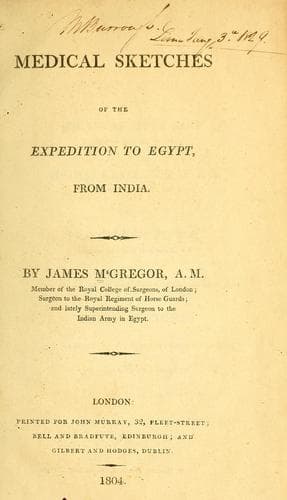
Medical Sketches of the Expedition to Egypt, from India — John Shaqi
Medical Sketches of the Expedition to Egypt, from IndiaMcGrigor, James, Sir
History
Medical Sketches of the Expedition to Egypt, from India
McGrigor, James, Sir
Great Britain. Army -- Sanitary affairs; Medicine, Military
On the morning of the 14th, I discovered a case of the plague in the
hospital of the 88th regiment: Anthonio, one of the hospital-cooks,
who had for thirty hours laboured under febrile symptoms, shewed me
two buboes in his groins. He had no venereal appearance, and the fever
was now attended with extreme irritability of the stomach. At the same
time, I was shewn another hospital-servant, a Hallancore, who lay next
to Anthonio. The Hallancore had been attacked in the night time, and,
when I saw him, had much fever and pain in the axilla, though I could
discover no swelling of the glands. As speedily as possible these two
men, and six other hospital-servants, who slept in the same apartment,
were removed to a house at the extremity of the town. A room was
immediately allotted, in the hospital of the 88th regiment, for cases
under observation.
To this every soldier, or follower, with febrile symptoms, was sent the
instant that the symptoms were discovered. A minute examination was made,
on the evening of the 14th, of all the men in the hospital, amounting
then to one hundred and sixty-two, in order to discover whether any
laboured under suspicious symptoms, but nothing was observed.
On the morning of the 15th, I discovered six men with fever, most of them
had been attacked in the night-time; they were sent without delay into
the observation-room, and most strictly guarded. By frequent observation,
in the course of the day, I discovered buboes in one, and pain in the
axillary and femoral glands of all the others: all were therefore sent
to the pest-house, which was now established.
Early on the morning of the 16th, the cook and Hallancore, first
attacked, died. It was found necessary in the course of the day to send
nine more men into the observation-room, where the nitrous fumigation
was very liberally used. After an emetic, I gave mercury very liberally
to the whole nine; but the symptoms, on the morning of the 18th, were so
unequivocal, that I sent them all to the pest-house.
Our situation now became very alarming. There were the clearest proofs
of the hospital which the 88th regiment occupied being thoroughly
infected, consisting of about fourteen or fifteen rooms, but all the
cases had hitherto come only from three of the rooms. Lamps for the
nitrous fumigation were kept constantly burning both in them and in the
observation-room. A very large building was procured near Rosetta; and,
with all possible haste, the men were moved to it.
Public-domain text, read in full here on John Shaqi.
Reviews
Reviews
No reviews yet
Be the first to share your thoughts on this work.
Join the Discussion
Join the discussion
Sign in to leave a comment or review.
Sign InorCreate an account