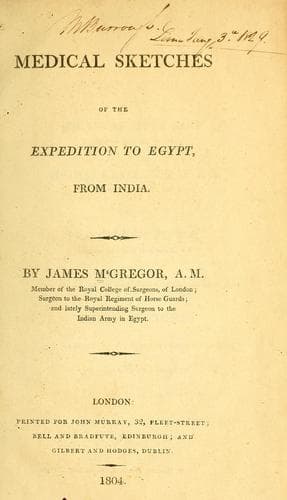
Medical Sketches of the Expedition to Egypt, from IndiaMcGrigor, James, Sir
History
Medical Sketches of the Expedition to Egypt, from India
McGrigor, James, Sir
Great Britain. Army -- Sanitary affairs; Medicine, Military
No man left the old hospital till all his clothes were washed; his hair
was cut short, and himself bathed. On coming to the outside walls of the
new hospital, every man stripped himself naked and went into a warm bath
before his reception into the hospital. He was then provided with new
clothing and bedding; the clothing brought with him was received by a
non-commissioned officer, who saw it repeatedly washed and baked, after
which it was received into the hospital store-room. On the evening of the
18th, I sent four more men into the observation-room, and, on the 21st,
three of them were sent into the pest-house. The other did well in the
observation-room.
On the 23d, Littlejohn, a boy, was sent in the morning to the
observation-room, having been attacked the night before with rigours. On
the 25th, Egan, another suspicious case, was also sent there. In both of
them a severe ptyalism was excited in less than forty-eight hours by
mercury and nitric acid, and they afterwards did well.
On the 28th, Craig, with febrile symptoms, was sent from the new hospital
to the observation-room of the old. His gums were speedily affected; but
it was found necessary to send him to the pest-house. This was the only
instance of the plague which appeared in the 88th regiment after their
removal to the new hospital.
The six native followers, first sent off, had no symptoms of the disease
for eight days after their arrival at the pest-house; but, on the 9th and
10th days after, all of them were attacked, and none survived the attack
three days. Four more of the Indian servants, sent to the pest-house to
attend the others, shared the same fate. The case of the Mukadum of the
Dooli-bearers was the most rapid.
On the 17th, he was attacked about nine o’clock in the morning with
rigours, and died before four o’clock. No instances of the plague
appeared in any other corps of the army during this month. Though they
attempted to conceal it, we discovered that some _accidents_ (as they
call it) had occurred about the beginning of September among the people
of the town.
The weather still continued the same during this, as the whole of last,
month. The same winds prevailed, without rain or anything remarkable. On
the 15th, 16th, and 17th, it blew from the westward: after this, we had
close calm weather.
After the 15th, the Nile at Rosetta began to recede. The general range of
the thermometer, in a house in Rosetta, was from 73° to 83° 50´.
After the plague, the most formidable disease in the army, from its
general prevalence, was ophthalmia. In the 10th and 88th regiment there
were upwards of three hundred and fifty cases. The total number in
the army exceeded six hundred. Dysentery and hepatitis prevailed very
generally among all the European corps; and the mortality of the month
was very considerable.
OCTOBER.
Public-domain text, read in full here on John Shaqi.
Reviews
Reviews
No reviews yet
Be the first to share your thoughts on this work.
Join the Discussion
Join the discussion
Sign in to leave a comment or review.
Sign InorCreate an account