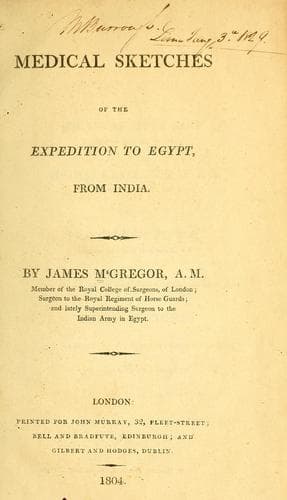
Medical Sketches of the Expedition to Egypt, from India — John Shaqi
Medical Sketches of the Expedition to Egypt, from IndiaMcGrigor, James, Sir
History
Medical Sketches of the Expedition to Egypt, from India
McGrigor, James, Sir
Great Britain. Army -- Sanitary affairs; Medicine, Military
In the beginning of this month, the encampment was moved from one to five
miles distance from Rosetta. The hospitals were gradually removed also
from hence. As the men recovered they were sent to a convalescent camp,
intermediate both to Rosetta and the general encampment, and precautions
were taken to prevent the men from intermingling with the inhabitants of
Rosetta.
Thatched regimental hospitals were built in the camp; and, though in
the middle of a desert, the sick soldier had a warm, comfortable, and
well-ventilated, apartment, and was liberally provided with every thing
conducive to his recovery. Early in the month, the garrison of Damietta
joined the army. The 86th regiment were healthy and suffered less from
ophthalmia than any European corps of the army. About the end of the
month, this corps was sent to Ghiza, and the detachments in garrison
there were ordered to join their respective corps.
The temperature of the air became sensibly lower than in the former
month, the extremes being from 69° 50´ to 80°. The medium was from 70° to
77°. The westerly was still the prevailing wind, and it often blew very
fresh. The atmosphere, towards the end of the month, was very cloudy;
and, though we had no rain during the month, it seemed often to threaten
it. Owing to the very strict precautions taken, little plague occurred
during the month.
From the time the sick of the 88th regiment were separated, and from
regulations regarding cleanliness and fumigation being rigidly adhered
to, the progress of the contagion was effectually suppressed in that
regiment. The European corps still continued to suffer from hepatitis and
dysentery, while the number of cases of ophthalmia, and the great degree
of violence in which this disease was now seen, were really alarming.
During the month, a case of the plague appeared in the 61st regiment.
He had been a patient in the regimental hospital in Rosetta, and caught
the disease from straggling through the town. The only other case which
occurred was a follower of the commissariate department.
NOVEMBER.
At the commencement of this month, the army was encamped at El Hammed.
The sick were in the thatched buildings, and the mortality bore but a
small proportion to the sickness. The 86th regiment were very healthy
in Ghiza. The weather during the month was different from what we had
experienced for a considerable time. The sky was constantly clouded, and
it often blew strongly from the west. It rained on fifteen days, and the
quantity of rain which fell during the month was considerable. On the
17th, there was much thunder and lightning. The dews were heavy, and
there was generally a thick fog which lasted till eight or nine in the
morning. The extreme ranges of the thermometer in my marquee were from
57° to 77°.
Public-domain text, read in full here on John Shaqi.
Reviews
Reviews
No reviews yet
Be the first to share your thoughts on this work.
Join the Discussion
Join the discussion
Sign in to leave a comment or review.
Sign InorCreate an account