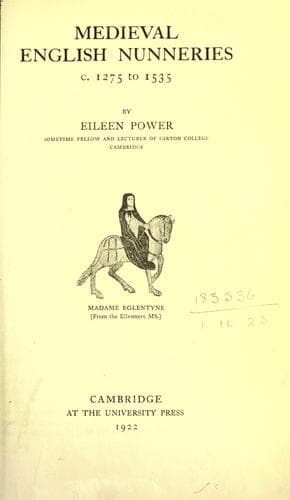
Medieval English Nunneries c. 1275 to 1535Power, Eileen
History
Medieval English Nunneries c. 1275 to 1535
Power, Eileen
Convents -- England; Monastic and religious life of women -- History
It has been shown that the proportion of women who became nuns was very
small in comparison with the total female population. It has indeed been
insufficiently recognised that the medieval nunneries were recruited
almost entirely from among the upper classes. They were essentially
aristocratic institutions, the refuge of the gently born. At Romsey Abbey
a list of 91 sisters at the election of an abbess in 1333 is full of
well-known county names[3]. The names of Bassett, Sackville, Covert,
Hussey, Tawke and Farnfold occur at Easebourne[4]; Lewknor, St John,
Okehurst, Michelgrove and Sidney at Rusper[5], the two small and poor
nunneries in Sussex. The return of the subsidy in 1377 enumerates the
sisters of Minchin Barrow and, as their historian points out, "among the
family names of these ladies are some of the best that the western
counties could produce"[6]. The other Somerset houses were equally
aristocratic, and an examination of the roll of prioresses for almost any
medieval convent in any part of England will give the same result, even in
the smallest and poorest nunneries, the inmates of which were reduced to
begging alms[7]. These ladies appear sometimes to have had the spirit of
their race, as they often had its manners and its tastes. For 21 years
Isabel Stanley, Prioress of King's Mead, Derby, refused to pay a rent due
from her house to the Abbot of Burton; at last the Abbot sent his bailiff
to distrain for it and she spoke her mind in good set terms. "Wenes these
churles to overlede me," cried this worthy daughter of a knightly family,
"or sue the lawe agayne me? They shall not be so hardy but they shall avye
upon their bodies and be nailed with arrows; for I am a gentlewoman, comen
of the greatest of Lancashire and Cheshire, and that they shall know right
well"[8]. A tacit recognition of the aristocratic character of the
convents is to be found in the fact that bishops were often at pains to
mention the good birth of the girls whom, in accordance with a general
right, they nominated to certain houses on certain occasions. Thus Wykeham
wrote to the Abbess of St Mary's Winchester, bidding her admit Joan
Bleden, "quest de bone et honeste condition, come nous sumes enformes"[9].
More frequently still the candidates were described as "domicella" or
"damoysele"[10]. At least one instance is extant of a bishop ordering that
all the nuns of a house were to be of noble condition[11].
Public-domain text, read in full here on John Shaqi.
Reviews
Reviews
No reviews yet
Be the first to share your thoughts on this work.
Join the Discussion
Join the discussion
Sign in to leave a comment or review.
Sign InorCreate an account