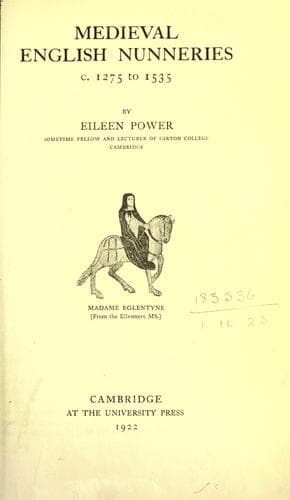
Medieval English Nunneries c. 1275 to 1535 — John Shaqi
Medieval English Nunneries c. 1275 to 1535Power, Eileen
History
Medieval English Nunneries c. 1275 to 1535
Power, Eileen
Convents -- England; Monastic and religious life of women -- History
The fact that the greater portion of the female population was unaffected
by the existence of the outlet provided by conventual life for women's
energies is a significant one. The reason for it--paradoxical as this may
sound--lies in the very narrowness of the sphere to which women of gentle
birth were confined. The disadvantage of rank is that so many honest
occupations are not, in its eyes, honourable occupations. In the lowest
ranks of society the poor labourer upon the land had no need to get rid of
his daughter, if he could not find her a husband, nor would it have been
to his interest to do so; for, working in the fields among his sons, or
spinning and brewing with his wife at home, she could earn a supplementary
if not a living wage. The tradesman or artisan in the town was in a
similar position. He recognised that the ideal course was to find a
husband for his growing girl, but the alternative was in no sense that she
should eat out her heart and his income during long years at home; and if
he were too poor to provide her with a sufficient dower, he could and
often did apprentice her to a trade. The number of industries which were
carried on by women in the middle ages shows that for the burgess and
lower classes there were other outlets besides marriage; and then, as now,
domestic service provided for many. But the case of the well-born lady was
different. The knight or the county gentleman could not apprentice his
superfluous daughters to a pursemaker or a weaver in the town; not from
them were drawn the regrateresses in the market place and the harvest
gatherers in the field; nor was it theirs to make the parti-coloured bed
and shake the coverlet, worked with grapes and unicorns, in some rich
vintner's house. There remained for him, if he did not wish or could not
afford to keep them at home and for them, if they desired some scope for
their young energies, only marriage or else a convent, where they might go
with a smaller dower than a husband of their own rank would demand.
Public-domain text, read in full here on John Shaqi.
Reviews
Reviews
No reviews yet
Be the first to share your thoughts on this work.
Join the Discussion
Join the discussion
Sign in to leave a comment or review.
Sign InorCreate an account