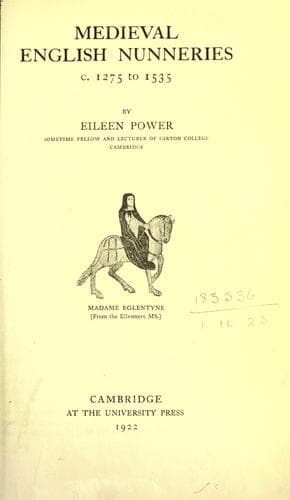
Medieval English Nunneries c. 1275 to 1535Power, Eileen
History
Medieval English Nunneries c. 1275 to 1535
Power, Eileen
Convents -- England; Monastic and religious life of women -- History
convents are mentioned once only and in some cases a testator leaves
legacies to nuns by name, without mentioning where they are professed. All
these houses were in the diocese of London and either in or near the
capital itself; they lay in the counties of Middlesex, Kent, Essex,
Hertford and Bedford[52]. It was but rarely that city girls went as far
afield as Denny in Cambridgeshire, where the famous fishmonger and mayor
of London, John Philpott, had a daughter Thomasina.
Thus the nobles, the gentry and the superior rank of burgess--the upper
and the upper-middle classes--sent their daughters to nunneries. But nuns
were drawn from no lower class; poor girls of the lowest rank--whether the
daughters of artisans or of country labourers--seem never to have taken
the veil. A certain degree of education was demanded in a nun before her
admission and the poor man's daughter would have neither the money, the
opportunity, nor the leisure to acquire it. The manorial fine paid by a
villein when he wished to put his son to school and make a religious of
him, had no counterpart in the case of girls[53]; the taking of the veil
by a villein's daughter was apparently not contemplated. The chief barrier
which shut out the poor from the nunneries was doubtless the dower which,
in spite of the strict prohibition of the rule, was certainly required
from a novice in almost every convent. The lay sisters of those nunneries
which had lay sisters attached were probably drawn mainly from the lower
class[54], but it must have been in the highest degree exceptional for a
poor or low-born girl to become a nun.
Public-domain text, read in full here on John Shaqi.
Reviews
Reviews
No reviews yet
Be the first to share your thoughts on this work.
Join the Discussion
Join the discussion
Sign in to leave a comment or review.
Sign InorCreate an account