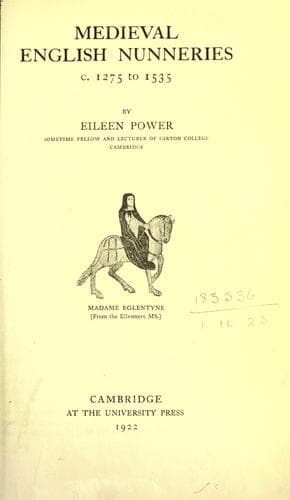
Medieval English Nunneries c. 1275 to 1535Power, Eileen
History
Medieval English Nunneries c. 1275 to 1535
Power, Eileen
Convents -- England; Monastic and religious life of women -- History
Medieval wills (our most trusty source of information for the _personnel_
of the nunneries) make it possible to gauge the extent to which the upper
and middle classes used the nunneries as receptacles for superfluous
daughters. In these wills, in which the medieval paterfamilias laboriously
catalogues his offspring and divides his wealth between them, it is easy
to guess at the embarrassments of a father too well-blessed with female
progeny. What was poor Simon the Chamberlain of the diocese of Worcester
to do, with six strapping girls upon his hands and sons Robert and Henry
to provide for too? Fortunately he had a generous patron in Sir Nicholas
de Mitton and it was perhaps Sir Nicholas who provided the dowers, when
two of them were packed off to Nuneaton; let us hope that Christiana,
Cecilia, Matilda and Joan married themselves out of the legacies which he
left them in his will, when he died in 1290[55]. William de Percehay, lord
of Ryton, who made his will in 1344, had to provide for five sons and one
is therefore not surprised to find that two of his three daughters were
nuns[56]. It is the same with the rich citizens of London and elsewhere;
Sir Richard de la Pole, of a great Hull merchant house (soon to be
ennobled), mentions in his will two sons and two daughters, one of whom
was a nun at Barking while the other received a legacy towards her
marriage[57]; Hugh de Waltham, town clerk, mentions three daughters, one
at St Helen's[58]; John de Croydon, fishmonger, leaves bequests to one son
and four daughters, one at Clerkenwell[59]; William de Chayham kept Lucy,
Agnes and Johanna with him, but made Juliana a nun[60]. The will of Joan
Lady Clinton illustrates the proportion in which a large family of girls
might be divided between the convent and the world; in 1457 she left
certain sums of money to Margaret, Isabel and Cecily Francyes, on
condition that they should pay four pounds annually to their sisters Joan
and Elizabeth, nuns[61]. It was not infrequent for several members of a
family to enter the same convent, as the lists of inmates given in
visitation records, or in the reports of Henry VIII's commissioners, as
well as the evidence of the wills, bear witness[62]. The case of
Shouldham, already quoted, shows that different generations of a family
might be represented at the same time in a convent[63], but it was perhaps
not usual for so many sisters to become nuns as in the Fairfax family; in
1393 their brother's will introduces us to Mary and Alice, nuns of
Sempringham, and Margaret and Eleanor, respectively prioress and nun of
Nunmonkton[64]. Margaret (of whom more anon) took convent life easily; it
is to be feared that she had all too little vocation for it. Sometimes
these family parties in a nunnery led to quarrels; the sisters
foregathered in cliques, or else they continued in the cloister the
domestic arguments of the hearth; there was an amusing case of the kind at
Public-domain text, read in full here on John Shaqi.
Reviews
Reviews
No reviews yet
Be the first to share your thoughts on this work.
Join the Discussion
Join the discussion
Sign in to leave a comment or review.
Sign InorCreate an account