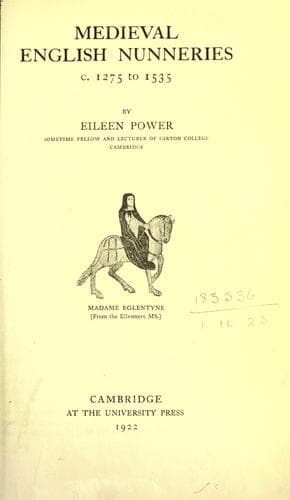
Medieval English Nunneries c. 1275 to 1535 — John Shaqi
Medieval English Nunneries c. 1275 to 1535Power, Eileen
History
Medieval English Nunneries c. 1275 to 1535
Power, Eileen
Convents -- England; Monastic and religious life of women -- History
Swine in 1268[65], and some years later (in 1318) an Archbishop of York
had to forbid the admission of more than two or three nuns of one family
to Nunappleton, without special licence, for fear of discord[66].
Probably the real factor in determining the social class from which the
convents were recruited, was not one of rank, but one of money. The
practice of demanding dowries from those who wished to become nuns was
strictly forbidden by the monastic rule and by canon law[67]. To spiritual
minds any taint of commerce was repugnant; Christ asked no dowry with his
bride. The didactic and mystical writers of the period often draw a
contrast between the earthly and the heavenly groom in this matter. The
author of _Hali Meidenhad_ in the thirteenth century, urging the convent
life upon his spiritual daughter, sets against his picture of Christ's
virgin-brides that of the well-born girl, married with disparagement
through lack of dower:
What thinkest thou of the poor, that are indifferently dowered and
ill-provided for, as almost all gentlewomen now are in the world, that
have not wherewith to buy themselves a bridegroom of their own rank
and give themselves into servitude to a man of low esteem, with all
that they have? Wellaway! Jesu! what unworthy chaffer[68].
Thomas of Hales' mystical poem _A Luue Ron_, in the same century, also
lays stress upon this point, half in ecstatic praise of the celibate
ideal, half as a material inducement[69], and the same idea is repeated at
the end of the next century in _Clene Maydenhod_:
He asketh with the nouther lond ne leode,
Gold ne selver ne precious stone.
To such thinges hath he no neode,
Al that is good is with hym one,
Gif thou with him thi lyf wolt lede
And graunte to ben his owne lemman[70].
In ecclesiastical language the same sentiment is expressed by the
injunction of Archbishop Greenfield of York, who forbade the nuns of Arden
to receive any one as a nun by compact, since that involved guilt of
simony, but only to receive her "from promptings of love"[71].
This sentiment was, however, set aside in practice from early times; and a
glance at any conventual register, such as the famous Register of Godstow
Abbey, shows something like a regular system of dowries, dating certainly
from the twelfth century. The Godstow Register contains 19 deeds, ranging
between 1139 and 1278, by which grants are made to the nunnery on the
entrance of a relative of the grantor, the usual phrase being that such
and such a man gave such and such rent-charges, pasture-rights, lands or
messuages, "with" his mother or sister or daughter "to be a nun"[72]. One
very curious deed dated 1259, shows that the reception of a girl at
Godstow was definitely a pecuniary matter. Ralph and Agnes Chondut sold to
the nunnery a piece of land called Anfric,
Public-domain text, read in full here on John Shaqi.
Reviews
Reviews
No reviews yet
Be the first to share your thoughts on this work.
Join the Discussion
Join the discussion
Sign in to leave a comment or review.
Sign InorCreate an account