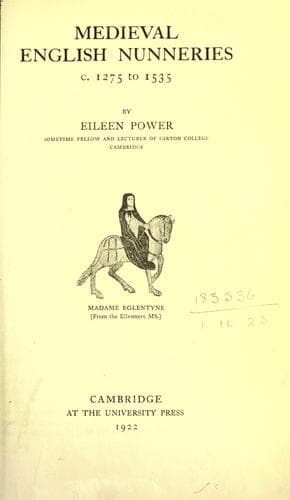
Medieval English Nunneries c. 1275 to 1535Power, Eileen
History
Medieval English Nunneries c. 1275 to 1535
Power, Eileen
Convents -- England; Monastic and religious life of women -- History
for thys quite claime and reles, the seyd abbas and holy mynchons of
Godstowe gafe to the seyde raph and Agnes hys wyfe liiiº marke, and
made Katherine the sustur of the seyd Agnes (wyfe of the seyd raph)
Mynchon in the monasteri of Godstowe, with the costys of the hows, ...
and the seyd holy mynchons of Godstowe shold pay to the seyd raph and
Agnes hys wyfe xxv marke of the forseyd liii marke in that day in
whyche the foreseyd Katerine should be delyuerd to hem to be norysshed
and to be mad mynchon in the same place and in the whyche the seyd
penyes shold be payd,
and a second instalment at a place to be agreed upon when confirmation of
the grant is obtained[73]. That is to say the price of the land was L35.
6_s._ 8_d._ together with the cost of receiving Katherine, which was
equivalent to a further sum of money, unfortunately not specified.
Any collection of wills provides ample evidence of this dowry system. Not
only do they frequently contain legacies for the support of some
particular nun during the term of her life, but bequests also occur for
the specific purpose of paying for the admission of a girl to a nunnery,
in exactly the same way as other girls are provided with dowries for their
marriage. The Countess of Warwick, in 1439, left a will directing "that
Iane Newmarch have cc mark in gold, And I to bere all Costes as for her
bryngynge yn-to seynt Katrens, or where-ever she woll be elles"[74]. Even
the clergy, who should have been the last to recognise a system so
flagrantly contrary to canon law, followed the general custom; William
Peke, rector of Scrivelsby, left one Isabella ten marks to make her a nun
in the Gilbertine house of Catley[75] and Robert de Playce, rector of the
church of Brompton, made the following bequest:
Item I bequeath to the daughter of John de Playce my brother 100_s._
in silver, for an aid towards making her a nun in one of the houses of
Wickham, Yedingham or Muncton, if her friends are willing to give her
sufficient aid to accomplish this, but if, through lack of assistance
from friends, she be not made a nun,
she was to have none of this bequest (1345)[76]. Sometimes, as has already
been noted, the money is left alternatively to marry the girl or to make
her a nun, which brings out very clearly the dower-like nature of such
bequests[77]. The accounts of great folk often tell the same tale. When
Elizabeth Chaucy--probably a relative of the poet Chaucer--became a nun at
Barking Abbey in 1381, John of Gaunt paid L51. 8_s._ 2_d._ in expenses and
gifts on the occasion of her admission[78], and the privy purse expenses
of Elizabeth of York contain the item, "Delivered to thabbesse of
Elnestowe by thands of John Duffyn for the costes and charges of litle
Anne Loveday at the making of her nonne there L6. 13_s._ 4_d._"[79].
Public-domain text, read in full here on John Shaqi.
Reviews
Reviews
No reviews yet
Be the first to share your thoughts on this work.
Join the Discussion
Join the discussion
Sign in to leave a comment or review.
Sign InorCreate an account