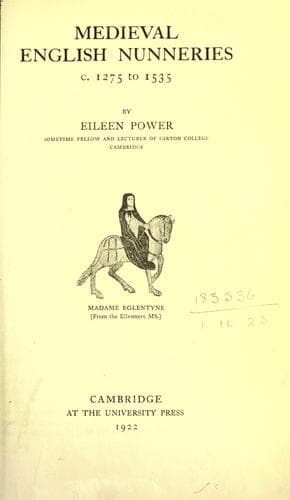
Medieval English Nunneries c. 1275 to 1535Power, Eileen
History
Medieval English Nunneries c. 1275 to 1535
Power, Eileen
Convents -- England; Monastic and religious life of women -- History
It is possible to determine the exact nature of these costs and charges
from an account of the expenses of the executors of Elizabeth Sewardby,
who died in 1468. This lady, the widow of William Sewardby of Sewardby,
had left a legacy of L6. 13_s._ 4_d._ to her namesake, little Elizabeth
Sewardby, to be given her if she should become a nun. The executors record
certain payments made to the Prioress of Nunmonkton during the period when
Elizabeth was a boarder there, before taking the vows, and then follows a
list of "expenses made for and concerning Elizabeth Sewardby when she was
made a nun at Monkton":
They say that they paid and gave to the Prioress and Convent of
Monkton, for a certain fee which the said Prioress and Convent _claim
by custom to have and are wont to have from each nun at her entrance_
L3. And in money paid for the habit of the said Elizabeth Sewardby and
for other attire of her body and for a fitting bed, L3. 13_s._
6-1/2_d._ And in expenditure made in connection with the aforesaid
Prioress and Convent and with the friends of the aforesaid Elizabeth
coming together on the Sunday next after the feast of the Nativity of
the Blessed Virgin Mary A.D. 1460, L3. 11_s._ 4_d._ In a gratuity
given to brother John Hamilton, preaching a sermon at the aforesaid
Monkton on the aforesaid Sunday, 2_s._ And in a certain remuneration
given to Thomas Clerk of York for his wise counsel concerning the
recovery of the debts due to the said dame Elizabeth Sewardby,
deceased, 12_d._ Total L10. 7_s._ 10-1/2_d._[80]
It will be noticed that Elizabeth took with her not only a lump sum of
money, but also clothes and a bed, the cost of which more than doubled the
dowry. Canon law specifically allowed the provision of a habit by friends,
when the poverty of a house rendered this necessary; and it is clear from
other sources that it was not unusual for a novice to be provided also
with furniture. The inventory of the goods belonging to the priory of
Minster in Sheppey, at the Dissolution, contains, under the heading of
"the greate Chamber in the Dorter," a note of
stuff in the same chamber belonging to Dame Agnes Davye, _which she
browghte with her_; a square sparver of payntyd clothe and iiij peces
hangyng of the same, iij payre of shets, a cownterpoynt of corse
verder and i square cofer of ashe, a cabord of waynscott carved, ij
awndyrons, a payre of tonges and a fyer panne.
And under "Dame Agnes Browne's Chamber" is the entry:
Public-domain text, read in full here on John Shaqi.
Reviews
Reviews
No reviews yet
Be the first to share your thoughts on this work.
Join the Discussion
Join the discussion
Sign in to leave a comment or review.
Sign InorCreate an account