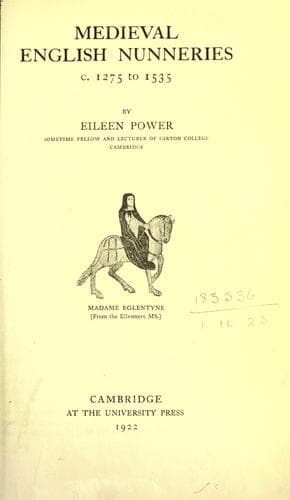
Medieval English Nunneries c. 1275 to 1535Power, Eileen
History
Medieval English Nunneries c. 1275 to 1535
Power, Eileen
Convents -- England; Monastic and religious life of women -- History
_Stuff given her by her frends_:--A fetherbed, a bolster, ij pyllowys,
a payre of blankatts, ij corse coverleds, iiij pare of shets good and
badde, an olde tester and selar of paynted clothes and ij peces of
hangyng to the same; a square cofer carvyd, with ij bad clothes upon
the cofer, and in the wyndow a lytill cobard of waynscott carvyd and
ij lytill chestes; a small goblet with a cover of sylver parcel gylt,
a lytill maser with a bryme of sylver and gylt, a lytyll pece of
sylver and a spone of sylver, ij lytyll latyn candellstyks, a fire
panne and a pare of tonges, ij small aundyrons, iiij pewter dysshes, a
porrenger, a pewter bason, ij skyllots, a lytill brasse pot, a
cawdyron and a drynkyng pot of pewter.
She had apparently been sent into the house with a complete equipment in
furniture and implements[81].
Throughout the middle ages a struggle went on between the Church, which
forbade the exaction of dowries, and the convents which persisted in
demanding them, sometimes in so flagrant a manner as to incur the charge
of simony. The earliest prohibition of dowries in English canon law
occurred at the Council of Westminster in 1175[82] and was repeated at the
Council of London in 1200[83] and at the Council of Oxford in 1222[84];
this last had been anticipated by a decree of the fourth Lateran Council.
The history of the struggle to apply it is to be gathered from
visitational records. Archbishop Walter Giffard, visiting Swine in 1268,
finds that Alicia Brun and Alicia de Adeburn were simoniacally veiled[85];
Bishop Norbury has to rebuke the Prioress of Chester for the simoniacal
receipt of bribes to admit nuns[86]; Bishop Ralph of Shrewsbury has heard
that the Prioress of Cannington received four women as sisters of that
house for L20 each, falling into the pravity of simony[87]; William of
Wykeham writes to the nuns of Romsey in 1387 that
in our said visitations it was discovered and declared that, on
account of the reception of certain persons as nuns of your said
monastery, several sums of money were received by the Abbess and
Convent by way of covenant, reward and compact, not without stain of
the pravity of simony and, if it were so, to the peril of your souls,
and he proceeds to forbid the exaction of a dowry "on pretext of any
custom (_consuetudinis_) whatsoever, which is rather to be esteemed a
corruption (_corruptela_)," a significant phrase, which shows that the
practice was well established[88]. Bishop Buckingham of Lincoln warns the
nuns of Heynings against "the reception or extortion of money or of
anything else by compact for the reception of anyone into religion"
(1392)[89]; and Bishop Flemyng enjoins at Elstow in 1422
Public-domain text, read in full here on John Shaqi.
Reviews
Reviews
No reviews yet
Be the first to share your thoughts on this work.
Join the Discussion
Join the discussion
Sign in to leave a comment or review.
Sign InorCreate an account