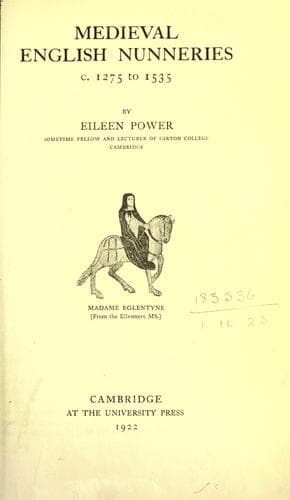
Medieval English Nunneries c. 1275 to 1535Power, Eileen
History
Medieval English Nunneries c. 1275 to 1535
Power, Eileen
Convents -- England; Monastic and religious life of women -- History
that hereafter fit persons be received as nuns; for whose reception or
entrance let no money or aught else be demanded; but without any
simoniacal bargain and covenant of any sum of money or other thing
whatsoever, which were accustomed to be made by the crime of simony,
let them henceforth be admitted to your religion purely, simply and
for nothing[90].
But the most detailed information as to the prevalence of the dowry-system
is contained in the records of Bishop Alnwick's visitations of religious
houses in the diocese of Lincoln in 1440[91]. When the Bishop came to
Heynings (which had already been in trouble under Bokyngham) one of the
nuns, Dame Agnes Sutton, gave evidence to the effect that
her friends came to the Prioress and covenanted that she should be
received as a nun for twelve marks and the said money was paid down
before she was admitted, and she says that no one is admitted before
the sum agreed upon for her reception is paid.
She added that nothing was exacted save what was a free offering, but from
her previous words it is obvious that no nuns were received at Heynings
without a dowry. Similarly at Langley Dame Cecily Folgeham said that her
friends gave ten marks to the house "when she was tonsured, but not by
covenant." The most interesting case of all was that of Nuncoton. The
Subprioress, Dame Ellen Frost, said "that it was the custom in time past
to take twenty pounds or less for the admission of nuns, otherwise they
would not be received." The Bishop proceeded to examine other members of
the house; Dame Maud Saltmershe confirmed what the Subprioress had said
about the price for the reception of nuns; two other ladies, who had been
in religion for fifteen and eight years respectively, deposed to having
paid twenty pounds on their entrance and Dame Alice Skotte said that she
did not know how much she had paid, but that she thought it was twenty
pounds. Clearly there was a fixed entrance fee to this nunnery and it was
impossible to become a nun without it; all pretence of free-will
offerings had been dropped. When it is considered that this entrance fee
was twenty pounds (i.e. about L200 of modern money) it is easy to see why
poor girls belonging to the lower orders never found their way into
convents; such a luxury was far beyond their means.
In each of these cases and at two other houses (St Michael's Stamford, and
Legbourne) Alnwick entered a stern prohibition, on pain of
excommunication, against the reception of anything except free gifts from
the friends of a novice. His injunction to Heynings may be quoted as
typical of those made by medieval bishops on such occasions:
Public-domain text, read in full here on John Shaqi.
Reviews
Reviews
No reviews yet
Be the first to share your thoughts on this work.
Join the Discussion
Join the discussion
Sign in to leave a comment or review.
Sign InorCreate an account