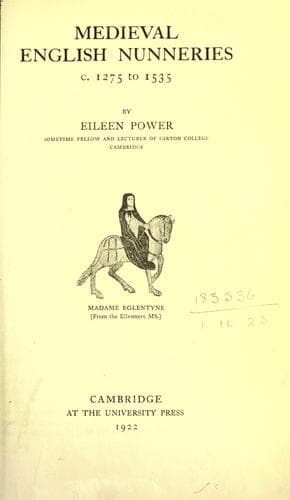
Medieval English Nunneries c. 1275 to 1535Power, Eileen
History
Medieval English Nunneries c. 1275 to 1535
Power, Eileen
Convents -- England; Monastic and religious life of women -- History
For as mykelle as we founde that many has been receyvede here afore
into nunne and sustre in your sayde pryory by covenaunt and paccyons
made be fore thair receyvyng of certeyn moneys to be payed to the
howse, the whiche is dampnede by alle lawe, we charge yowe under the
payn of the sentence of cursyng obove wrytene that fro hense forthe ye
receyve none persons in to nunne ne sustre in your sayde pryore by no
suche couenant, ne pactes or bargaines made before. Whan thai are
receyvede and professede, if thaire frendes of thaire almesse wylle
any gyfe to the place, we suffre wele, commende and conferme hit to be
receyvede[92].
But the efforts at reform made by Alnwick and other visitors were never
very successful; Nuncoton evidently continued to demand its entrance fee,
for in 1531 the practice was once more forbidden by Bishop Longland[93].
Moreover it is easy to see that the distinction between the reception of
what was willingly offered by friends (which was specifically permitted by
the rule of St Benedict and by synods and visitors throughout the middle
ages), and what was given by agreement as payment for the entry of a
novice (which was always forbidden) might become a distinction without a
difference, as it clearly was in the case of Heynings quoted above. The
Prioress of Gokewell, who declared to Alnwick that "they take nothing for
the admission of nuns, save that which the friends of her who is to be
created offer of their free-will and not by agreement"[94], may have acted
in reality not very differently from her erring sisters of Heynings,
Nuncoton and Langley. The temptation was in fact too great. The clause of
the Oxford decree, which permitted poor houses if necessary to receive a
sum sufficient for the vesture of a new member and no more, broadened the
way already opened by the permission of free-will offerings. The
concluding words of Bishop Flemyng's prohibition of dowries at Elstow in
1422 show that this permission had been abused; "if they must be clothed
at their own or their friends' expense, let nothing at all be in any sort
exacted or required, beyond their garments or the just price of their
garments"[95]. Throughout the later middle ages an increase in the cost of
living went side by side with a decrease in the monastic ideal of poverty,
showing itself on the one hand in the constant breach of the rule against
private property, on the other in the exaction of money with novices,
until the dowry system (although never during the middle ages recognised
by law) became in practice a matter of course.
Public-domain text, read in full here on John Shaqi.
Reviews
Reviews
No reviews yet
Be the first to share your thoughts on this work.
Join the Discussion
Join the discussion
Sign in to leave a comment or review.
Sign InorCreate an account