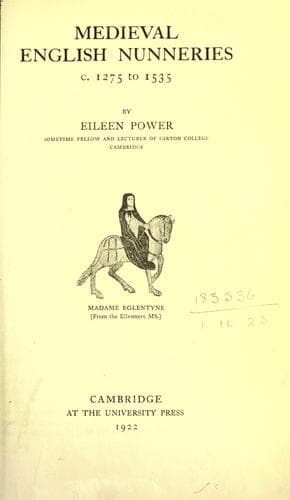
Medieval English Nunneries c. 1275 to 1535Power, Eileen
History
Medieval English Nunneries c. 1275 to 1535
Power, Eileen
Convents -- England; Monastic and religious life of women -- History
Lest it should seem that everyone who had enough money could become a nun,
it must, however, be added that the bishops took some pains that the
persons who were received as novices should be suitable and pleasing to
their sisters. They seldom exercised their right of nomination without
some assurance that their nominee was of honest life and station,
"Mulierem honestam, ut credimus"[96], "bonae indolis, ut credimus,
juvenculam"[97], "jeovene damoisele et de bone condicion, come nous sumez
enformez"[98], "competeter ad hujusmodi officii debitum litterate"[99].
They were always ready to hear complaints if unsuitable persons had been
admitted by the prioress; and they sometimes made special injunctions upon
the matter. Bokyngham at Heynings in 1392 ordered "that they receive no
one to the habit, nor even to profession, unless she be first found by
diligent inquisition and approbation to be useful, teachable, capable, of
legitimate age, discreet and honest"[100]. At Elstow Bishop Gray made a
very comprehensive injunction:
Furthermore we enjoin and charge you the Abbess ... that henceforward
you admit no one to be a nun of the said monastery, unless with the
express consent of the greater and sounder part of the same convent;
and no one in that case, unless she be taught in song and reading and
the other things requisite herein, or probably may be easily
instructed within short time, and be such that she shall be able to
bear the burdens of the quire (with) the rest that pertain to
religion[101].
Nevertheless, for all their precautions, some strange inmates found their
way into the medieval nunneries.
The novice who entered a nunnery, to live there as a nun for the rest of
her natural life, might do so for very various reasons. For those who
entered young and of their own will, religion was either a profession or a
vocation. They might take the veil because it offered an honourable career
for superfluous girls, who were unwilling or unable to marry; or they
might take it in a real spirit of devotion, with a real call to the
religious life. For other girls the nunnery might be a prison, into which
they were thrust, unwilling but often afraid to resist, by elders who
wished to be rid of them; and many nunneries contained also another class
of inmates, older women, often widows, who had retired thither to end
their days in peace. A career, a vocation, a prison, a refuge; to its
different inmates the medieval nunnery was all these things.
Public-domain text, read in full here on John Shaqi.
Reviews
Reviews
No reviews yet
Be the first to share your thoughts on this work.
Join the Discussion
Join the discussion
Sign in to leave a comment or review.
Sign InorCreate an account