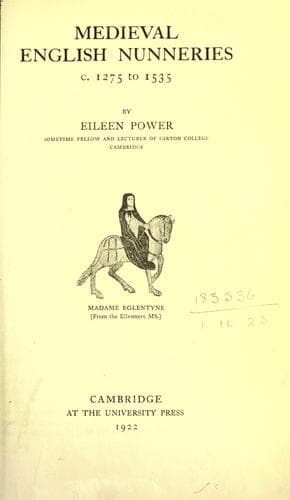
Medieval English Nunneries c. 1275 to 1535Power, Eileen
History
Medieval English Nunneries c. 1275 to 1535
Power, Eileen
Convents -- England; Monastic and religious life of women -- History
The occasional cases in which wives left their husbands to enter a convent
were less likely to provoke discord. Such women as left husband and
children to take the veil must have been moved by a very strong vocation
for religion, or else by excessive weariness. Some may perhaps have found
married life even such an odious tale, "a licking of honey off thorns," as
the misguided realist who wrote _Hali Meidenhad_ sought to depict it. In
any case, whether the mystical faith of a St Bridget drew her thither, or
whether matrimony had not seemed easy to her that had tried it, the
presence of a wedded wife was unlikely to provoke discord in the convent;
the devout and the depressed are quiet bedeswomen. It was necessary for a
wife to obtain her husband's permission before she could take the veil,
since her action entailed celibacy on his part also, during her lifetime.
Sometimes a husband would endow his wife liberally on her entry into the
house which she had selected. There are two such dowers in the Register of
Godstow Nunnery. About 1165 William de Seckworth gave the tithes of two
mills and a grant of five acres of meadow to the convent, "for the helth
of hys sowle and of hys chyldryn and of hys aunceters, with hys wyfe also,
the whyche he toke to kepe to the forseyd holy mynchons to serve
god"[148]; and a quarter of a century later Geoffrey Durant and Molde his
wife, "whan şe same Moole yelded herself to be a mynchon to the same
chirch," granted one mark of rent to be paid annually by their son Peter,
out of certain lands held by him, "which were of the mariage of the said
Moolde"[149]. Nor did Walter Hauteyn, citizen of London, in his solicitude
for his son and three daughters, forget the mother who had left her
husband and children for the service of God; to Alice his wife, a nun of
St Sepulchre's Canterbury, he bequeathed in 1292 his dwelling place and
rents upon Cornhill for life, with remainder to his heirs[150].
CHAPTER II
THE HEAD OF THE HOUSE
"My lady Prioresse, by your leve
So that I wiste I sholde you not greve,
I wolde demen that ye tellen sholde
A tale next, if so were that ye wolde.
Now wol ye vouche-sauf, my lady dere?"
"Gladly" quod she, and seyde as ye shal here.
CHAUCER.
Public-domain text, read in full here on John Shaqi.
Reviews
Reviews
No reviews yet
Be the first to share your thoughts on this work.
Join the Discussion
Join the discussion
Sign in to leave a comment or review.
Sign InorCreate an account