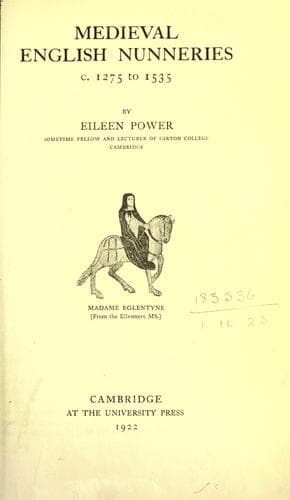
Medieval English Nunneries c. 1275 to 1535Power, Eileen
History
Medieval English Nunneries c. 1275 to 1535
Power, Eileen
Convents -- England; Monastic and religious life of women -- History
The election of a superior was a complicated business, as may be gathered
from the list of seventeen documents relating to the election of Alice de
la Flagge as Prioress of Whiston in 1308, and enrolled in the _Sede
Vacante_ Register of Worcester diocese[154]. Indeed there were so many
formalities to be fulfilled that the nuns seem often to have found great
difficulty in making a canonical election, and there are frequent notices
in the episcopal registers that their election has been quashed by the
Bishop on account of some technical fault; in such cases, however, the
Bishop's action was merely formal and he almost always reappointed the
candidate of their choice[155]. An election was, moreover, not only
complicated but expensive; it began with a journey to the patron to ask
for his _conge d'elire_ and it ended with more journeys, to the patron and
to the Bishop, to ask for confirmation, so that the cost of travel and the
cost of paying a clerk to draw up the necessary documents were sometimes
considerable; moreover a fee was payable to the Bishop's official for the
installation of the new head. The account of Margaret Ratclyff, Prioress
of Swaffham Bulbeck in 1482, contains notice of payments "to the official
of the lord bishop, at the installation of the said prioress for his fee
i. li." and to one Bridone "for the transcript of the decree of election
of the prioress v. s."[156]. An account roll of St Michael's Stamford for
the year 1375-6 illustrates the process in greater detail; under the
heading of "expenses de nostre Elit" are the following items:
Paid for the hire of horses with expenses going to the abbot of
Peterborough [the patron] to get licence to elect our choice 9-1/2_d._
Paid for the hire of horses going to the bishop of Lincoln and to the
abbot of Peterborough and for their expenses at our election 4_s._
8-1/2_d._ Paid for bread, ale and meat for our election on the
election day 2_s._ 11-1/2_d._ Paid for a letter to the abbot of
Peterborough for a licence to elect 3_d._ Paid for the installation of
our elect, 10_s._[157] Total 18_s._ 8-1/2_d._[158]
The only necessary qualifications for the head of a house were that she
should be above the age of twenty-one[159], born in wedlock and of good
reputation; a special dispensation had to be obtained for the election of
a woman who was under age or illegitimate.
[Illustration: PLATE II
ABBESS RECEIVING THE PASTORAL STAFF FROM A BISHOP
BENEDICTION OF AN ABBESS BY A BISHOP]
As a rule the nuns possessed the right of free election, subject to the
_conge d'elire_ of their patron and to the confirmation of the bishop, and
they secured without very much difficulty the leader of their choice.
Often enough it must have been clear, especially in small communities,
that one of the nuns was better fitted to rule than her sisters, and, as
at Whiston, they
Public-domain text, read in full here on John Shaqi.
Reviews
Reviews
No reviews yet
Be the first to share your thoughts on this work.
Join the Discussion
Join the discussion
Sign in to leave a comment or review.
Sign InorCreate an account