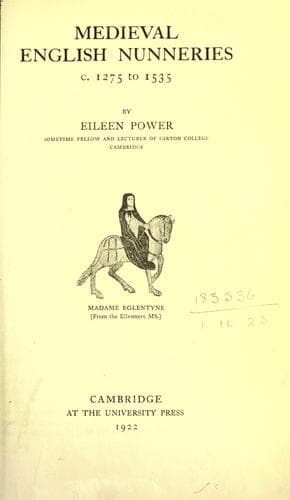
Medieval English Nunneries c. 1275 to 1535 — John Shaqi
Medieval English Nunneries c. 1275 to 1535Power, Eileen
History
Medieval English Nunneries c. 1275 to 1535
Power, Eileen
Convents -- England; Monastic and religious life of women -- History
unanimously, as if inspired by the Holy Spirit[160], chose dame Alice
de la Flagge, a woman of discreet life and morals, of lawful age,
professed in the nunnery, born in lawful matrimony, prudent in
spiritual and temporal matters, of whose election all approved, and
afterwards, solemnly singing Te Deum Laudamus, carried the said elect,
weeping, resisting as much as she could, and expostulating in a high
voice, to the church as is the custom, and immediately afterwards,
brother William de Grimeley, monk of Worcester, proclaimed the
election. The said elect, after being very often asked, at length,
after due deliberation, being unwilling to resist the divine will,
consented[161].
But Jocelin of Brakelond has taught us that a monastic election was not
always a foregone conclusion, that discussion waxed hot and barbed words
flew in the season of blood-letting "when the cloistered monks were wont
to reveal the secrets of their hearts in turn and to discuss matters one
with another," and that "many men said many things and every man was fully
persuaded in his own mind." Nuns were not very different from monks when
it came to an election, and the chance survival of a bishop's register and
of another formal document among the muniments of Lincoln, has preserved
the record of an election comedy at Elstow Abbey, almost worthy to rank
with Jocelin's inimitable account of the choice of Samson the subsacrist.
After the death of Abbess Agnes Gascoigne in July 1529, the nineteen nuns
of Elstow, having received Henry VIII's _conge d'elire_, assembled in
their chapter house on August 9th, to elect her successor. They chose
Master John Rayn "_utriusque juris doctorem_," as director, Edward Watson,
notary public as clerk, and the Prior of Caldwell and the rectors of Great
Billing and Turvey as witnesses. Three novices and other lay persons
having departed, the director and the other men explained the forms of
election to the nuns in the vulgar tongue and they agreed to proceed by
way of scrutiny. Matilda Sheldon, subprioress, Alice Boifeld,
_precentrix_, and Anne Preston, _ostiaria_ (doorkeeper) were chosen as
scrutineers and withdrew into a corner of the chapter house, with the
notary and witnesses. There Matilda Sheldon and Anne Preston nominated
Cecilia Starkey, _refectoraria_, while Alice Boifeld nominated Elizabeth
Boifeld, sacrist, evidently a relative. The three scrutineers then called
upon the other nuns to give their votes; Anne Wake, the prioress, named
Cecilia Starkey; Elizabeth Boifeld and Cecilia Starkey (each unable to
vote for herself, but determined not to assist the other) voted for a
third person, the subsacrist Helen Snawe; and Helen Snawe and all the
other nuns, except two, gave their votes in favour of Elizabeth Boifeld.
Consternation reigned among the older nuns, prioress, subprioress,
_refectoraria_ and doorkeeper, when this result was announced. "Well,"
Public-domain text, read in full here on John Shaqi.
Reviews
Reviews
No reviews yet
Be the first to share your thoughts on this work.
Join the Discussion
Join the discussion
Sign in to leave a comment or review.
Sign InorCreate an account