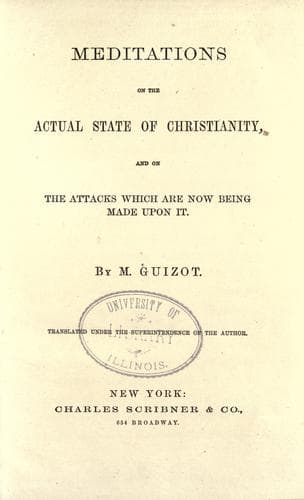
Meditations on the Actual State of Christianity, and on the Attacks Which Are Now Being Made Upon It.Guizot, François
Religion
Meditations on the Actual State of Christianity, and on the Attacks Which Are Now Being Made Upon It.
Guizot, François
Christianity; Philosophy and religion; Religious thought -- 19th century
outrageous and barbarous writer. A new era opened at this epoch
in France for religion and for literature.
{21}
Christianity and systems opposed to Christianity, Roman
Catholicism, Protestantism, and Philosophy, a taste for classics,
and a tendency to romanticism, unfolded themselves
simultaneously, surprised to be living together, and at the same
time encountering one another as ardent combatants.
I have no design to retrace here their contests nor to constitute
myself their judge. Let but a great arena be thrown open, and the
crowd rushes in, carrying with it its confusion and its buzz.
Happily, the tumult is not of long duration. In this mighty
movement of men's minds in France at the commencement of the
nineteenth century I occupy myself with a single grand fact--the
Awakening of Christianity, its different characteristics, its
different results. The crisis itself had illustrious witnesses. I
will interrogate these alone.
After Napoleon and Chateaubriand, the first whom I meet with are
two Catholic writers, who have left behind them great and
deserved reputations. M. de Bonald and M. de Maistre hoisted the
banner of Christianity valiantly, and at an early date.
{22}
But their ideas and their writings were rather political than
religious: the exigencies of public order occupied their
attention far more than those of man's soul, and their works were
rather attacks upon the French Revolution than a defense of the
faith of Christians. By a coincidence very remarkable, although
at the same time very natural, the first production of each--"The
Theory of Power," by M. de Bonald, and the "Considerations on
France," by M. de Maistre--was published at the same moment, in
1796, and each in a foreign land, where the authors were living
as emigrants. In the first ardor of the reaction, and with the
impassioned and vague feelings that it suggested, each wrote
against the Revolution that shook the world and wrecked his own
fortunes. Potent intelligences both, profound moralists, eminent
writers; but their philosophy is a philosophy of circumstance and
of party. Their theories they use as arms; their books as a
discharge.
{23}
M. de Bonald is a lofty-minded original thinker, but subtle, too,
and complex; disposed to content himself with verbal combinations
and distinctions, and sparing no labor to contrive his vast web
of arguments proper to entrap the unwary adversary. M. de
Maistre, on the contrary, blasts him with the absoluteness of his
assertion, the poignancy of his irony, the rude eloquence of his
invectives. He is a powerful, a charming extemporizer. Both of
them excel in seizing and presenting in a striking manner one
great side, but only one of the great sides, in questions or
measures. They see not these in their variety and in their
entirety. Combatants approved--the one tenacious, the other
impetuous--they both committed two grave faults: they instituted
a closer bond between statesmanship and religion than is proper
Public-domain text, read in full here on John Shaqi.
Reviews
Reviews
No reviews yet
Be the first to share your thoughts on this work.
Join the Discussion
Join the discussion
Sign in to leave a comment or review.
Sign InorCreate an account