Messages from the Epistle to the Hebrews — John Shaqi
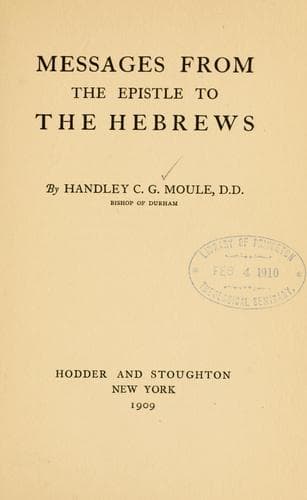
Messages from the Epistle to the HebrewsMoule, H. C. G. (Handley Carr Glyn)
Religion
Messages from the Epistle to the Hebrews
Moule, H. C. G. (Handley Carr Glyn)
Bible. Hebrews -- Commentaries
What the prophet foretold was claimed by the Lord Christ Himself, as
fulfilled in His Person and His work, when He took the cup of blessing,
at the feast of the new Passover of the new Israel, and said, "This cup
is the new covenant in my blood." And what He so claimed His great
apostle rejoiced in, when he wrote to Corinth (2 iii. 6, etc.) of the
"ministry of the new covenant," the covenant of the Spirit, of life, of
glory. And here the same truth is stated again, and in strong connexion
again with Him who is at once its Sacrifice, its Surety, its Mediator;
the Cause, and Guardian, and Giver of all its blessings. He is such that
it is such; ours is "_so great_ a salvation," because of so great and
wonderful a High Priest, the possessor in very deed of "somewhat to
offer," and now, with hands full of the fruits of that offering,
"seated" for us "on the right hand of the throne of the majesty in the
heavens."
Here is a message for our times, in a sense which seems to me special,
pressing, and deeply beneficent. For the terms of that new covenant are
nothing less than the glorious essence, the Divine peculiarity, of the
Gospel of the grace of God. This forgiveness, this most sincere and
entirely unearned amnesty, this oblivion of the sins of the people of
God--do we hear very much about it now, even where by tradition it might
be most expected? But do we not need it now? Was there ever a time when
human hearts would be more settled and more energized than now, amidst
their moral restlessness, by a wise, thoughtful, but perfectly
unmistakable reaffirmation of the sublime fulness of Divine forgiveness
in Christ? Men may think that they can do without that message. They may
bid us throw the whole weight of preaching upon self-sacrifice, upon
social service, upon conduct at large. But the fully wakeful soul knows
that it is only then capacitated for self-sacrifice in the Lord's
footsteps when it has received the warrant of forgiveness, written large
in His sacred blood, finding pardon and peace at the foot of His
sacrificial Cross. Then turn to the second limb of the covenant, a limb
greater even than the first, inasmuch as for it the first is provided
and guaranteed. Do we hear too much about this covenant blessing now? Do
our pulpits too frequently and too fully give out the affirmation that
God in Christ stands pledged and covenanted to work the moral
transfiguration of His believing Israel, to act so on "the first springs
of thought and will" that our being shall freely respond to His free
action upon it, and will His will, and live His law? But was there ever
greater need for such an affirmation than in our time, so restless, so
unsatisfied, and, deep below all its superficial arrogance, so
disappointed, so discouraged?
Public-domain text, read in full here on John Shaqi.
Reviews
Reviews
No reviews yet
Be the first to share your thoughts on this work.
Join the Discussion
Join the discussion
Sign in to leave a comment or review.
Sign InorCreate an account