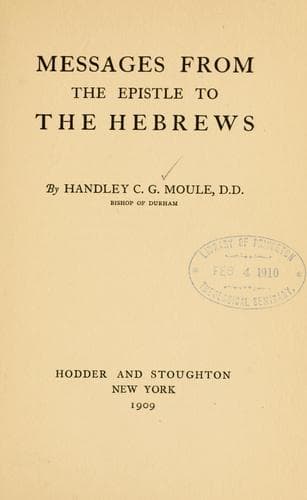
Messages from the Epistle to the HebrewsMoule, H. C. G. (Handley Carr Glyn)
Religion
Messages from the Epistle to the Hebrews
Moule, H. C. G. (Handley Carr Glyn)
Bible. Hebrews -- Commentaries
It demands an effort--and it well deserves an effort--to realize in some
measure what the trial must have been for the sensitive mind of many a
Jewish convert to look thus from the Gospel to the Law as both shewed
themselves to him then. Even now the earnest and religious Jew, invited
to accept the faith of Jesus, has his tremendous difficulties of
thought, as we well know, although for so many ages Jerusalem has been
"trodden down," and the priesthood and sacrifices have become very
ancient history. But when our Epistle was written it was far otherwise.
True, the great ruin of the old order was very near at hand, but not to
the common eye and mind. It may be--for all things are possible--that
the Papal system may be near its period; but certainly there is little
look of it to the traveller who visits Rome and contemplates St. Peter's
and the Vatican. As little did the end of the Mosaic age present itself
as probable, judging by externals, to the pilgrim to Jerusalem then,
when, for example, the innumerable hosts of Passover-keepers filled the
whole environs of the city, and moved incessantly through the vast
courts around the sacred space where the great altar sent up its smoke
morning and evening, and where the wonderful House stood intact, "a
mountain of snow pinnacled with gold."
Think of the contrast between such historic invitations to "walk by
sight" towards the bosom of Abraham, and the call to "come out and be
separate" in some Christian upper-room, devoid of every semblance of
decorative art and dignified proportion, only to listen to the Word, to
pray and praise in the name of the Crucified, and to eat and drink at
the simple Eucharist, the rite of Thanksgiving for--the Master's awful
death!
Recollecting these facts of the position, it is no wonder that the
Writer emphasizes the greatness and glory of faith, and that now he
devotes this whole noble and extended chapter to illustrate that glory.
We come thus to the opening words of the passage, and listen to him as
he takes the word "faith" up, and sets it apart, to look afresh at its
significance and to describe its potency, before he proceeds, with the
tact and skill of sympathy, to illustrate his account of it from the
history so deeply sacred to the tried Hebrew Christian's heart.
Public-domain text, read in full here on John Shaqi.
Reviews
Reviews
No reviews yet
Be the first to share your thoughts on this work.
Join the Discussion
Join the discussion
Sign in to leave a comment or review.
Sign InorCreate an account